Category Archives: General Affordability Updates

City Should Aim For Midyear Budget Amendments

By Bill Oakey – November 18, 2025

Some Budget Cuts Can Be Restored Midyear

There is a mad scramble at City Hall to slash the current fiscal year budget, in the light of Prop Q’s failure. Employee unions for police, fire and EMS are pushing hard to keep staffing levels and pay increases that were in the Prop Q budget. Other civic groups are clamoring for funding of services that they say are vital to the community.

The missing element in these frantic discussions is the strong message that voters sent to City Hall when they overwhelmingly rejected Prop Q – We want more transparency, efficiency and accountability in City spending. In my nearly 40 years of following City Budget battles, I have rarely ever seen a City Hall led discussion about how to make meaningful reforms to hold down costs to taxpayers. You can mark this month on your calendars – The Day of Reckoning has finally arrived!

The City Manager’s Plan Could Lead to Midyear Budget Adjustments

City Manager, TC Broadnax issued a memo the day after the Prop Q election. It outlines several steps he plans to take in an efficiency review. You can read about it here in a KXAN News story.  Here is the City Manager’s memo, “Efficiency and Optimization of City Services in Fiscal Year 2026.” The strategies include:

Independent assessment of operational efficiency and service delivery.

Benchmarking against comparable organizations to identify best practices.

Data-driven analysis of resource allocation and organizational design.

Recommendations for cost savings, service improvements, and structural adjustments.

In addition to these initiatives, City Council member, Marc Duchen and his staff are leading the effort to seek out as many cost-saving options as possible.

Perhaps a Midyear Budget Revision Could Take Effect on April 1st

The efficiency reviews, and there could indeed be more than one, will most likely play out over many months, if not years. But I am not April-fooling when I suggest that the City should set a goal of identifying cost-savings that could restore some essential City services halfway through this fiscal year.

And What About Those Huge Homeless Services Contracts?

As the raucous voices put forth their choices at City Hall this week, regarding spending cuts, I have not heard any words ECHO-ing off the wall (pun fully intended) about renegotiating homeless services contracts. Austin has by far the highest local cost share of homeless spending in the entire state. It’s the Day of Reckoning, so reforms are beckoning!

The ultimate goal should be to apply significant cost savings towards taxpayer relief in future budget years. The national affordability crisis will likely persist for quite some time. I recommend establishing a Taxpayer Reserve Fund, to be used for lowering taxes in subsequent years.

Fingers crossed that the folks at City Hall will heed the voters’ message. Their duty is not to just argue about cutting vital services. It’s the structural and cultural attitudes about spending that need to be addressed. Otherwise, few among us will be impressed.

Musical Accompaniment for This Blog Piece:

1. “Halfway to Paradise” – Tony Orlando

2. “Half the Way” – Crystal Gayle

A Joyous Night For Taxpayers – Prop Q Walloped!

By Bill Oakey – November 6, 2025

A Lopsided Victory That Will Wake Up City Hall

The final result was 63% to 37%. That capped off a long Tuesday evening of anxious waiting. The polls closed at 7:00, but the Travis County Elections website did not post early vote totals until almost 9:30. The reason for the delay spoke volumes about voter sentiment on Prop Q. People were still standing in line to vote, an hour and fifteen minutes after the polls closed!

Heads are now rolling at City Hall. Whether our leaders will change their free-spending ways is still up in the air. For far too long, they have been living in a bubble.

Mayor Kirk Watson quickly issued a post-election statement saying, “We should hear them, learn from this election, and trust our voters.” But many of us wonder how he could have misread the national affordability crisis to begin with.

Mayor Pro Tem Vanessa Fuentes Still Doesn’t Get It

On her Facebook post after the election, she made these comments:

“Finding a new path forward means cutting $110 million from the proposed budget. These cuts will have real and serious consequences – that could mean fewer paramedics on shift, fewer families receiving rental assistance and access to food programs, longer wait times for emergency services, and reductions in park maintenance and public health outreach – all at a time when many in our city need more help, not less.”

Austinites have a long history of showing support for essential City services and a high quality of life. But a 20% tax increase that would create a permanent annual slush fund of over $100 million was simply too much for taxpayers to swallow. The specific items that Ms. Fuentes cited could still be funded over time, and probably sooner rather than later. They will simply have to manage their budget the same way that Austin families have to do. We cannot afford everything that we want during an affordability crisis. And, we often make tradeoffs to balance buying the things that we need the most. It all comes to that concept known as fiscal responsibility.

Thank Goodness for City Council Member Marc Duchen!

Marc was the only Council member to vote against putting Prop Q on the ballot. Now, his office will be the strongest voice for meaningful reforms, to set the City onto the right track. I am in regular contact with his office, and hopefully there will be some good news to report on this blog in the coming days and weeks ahead. Stay tuned…

Musical Accompaniment for This Blog Piece:

1.”Such a Night” – 1960 Elivis Presley version

2. “Such a Night” – 1954 original version by the Drifters, featuring Clyde McPhatter.

Letter To The Editor

This was published in the Austin American-Statesman on Sunday, October 12, 2025

No End for Prop Q

I urge you to vote No on Proposition Q on Nov. 4. This Tax Rate Election could unleash one of the biggest property tax increases in Austin history. The city has declared a $33 million budget shortfall, but Prop Q would deliver $100 million to a fiscally irresponsible city government.

They are completely tone deaf to the hardships we face in this tough economy. Homeowners, small businesses and renters would all be hurt. Let’s join the Austin Chamber of Commerce in opposing Prop Q. The first year of this tax increase is only the beginning. Once a tax rate has been adopted, it becomes the new baseline for the next budget year. Then each year, more new taxes can be piled on top of it.

Please alert your friends and neighbors that Prop Q is a forever tax. I have been closely following affordability issues since 1983. The new budget can be trimmed. The city needs only to look at homeless program spending in other major Texas cities to find big cost savings.

Imagine standing on a hill, looking down on a winding road that vanishes into the sunset. Markers in the road show year after year of $100 million Austin tax increases. Like The Highwaymen used to sing, “The Road Goes On Forever.” But not if you vote No on Prop Q!

Bill Oakey, AustinAffordability.com

Chamber Of Commerce Opposes Prop Q

By Bill Oakey – October 8, 2025

I am quite happy to share this news! Here is their statement, from this weblink.

Austin Chamber Board of Directors Opposes Proposition Q
City of Austin Tax Rate Election

On November 4th, voters in Austin will head to the polls to consider a tax rate election that would increase property tax rates in the City of Austin by over 16%. Austin has experienced strong economic growth in recent years, but with this success has come significant challenges, chief among them is affordability. Over the past ten years, the typical Austin homeowner’s tax bill has increased by over 65%. This trajectory is unsustainable and at a time of great economic uncertainty, it is imperative that our local governments exercise fiscal restraint. The City Manager’s original budget stayed within the maximum allowed increase without requiring a tax rate election. That budget also fully funded core services including public safety.

Last month, the Austin Chamber wrote to Mayor Watson and Council Members urging Council to minimize property tax increases on residents and businesses. We recognize the challenging circumstances surrounding this year’s budget but were disappointed with the Council’s near unanimous decision to increase property taxes by over 16%. This increase is on top of higher than normal increases in several other taxing jurisdictions including Travis County and Central Health. Austin must remain an attractive destination for economic development and job growth, and this dramatic increase in taxes will likely push people out of Austin and negatively impact our ability to attract new investments in our city. Businesses in Austin experience an outsized share of rising fiscal pressures, and the Austin Chamber remains concerned that further property tax increases will lead to more businesses moving out of our city.

It is for these reasons that the Austin Chamber Board of Directors opposes the City of Austin’s Tax Rate Election on this November’s ballot. If we fail to prioritize affordability today, we risk losing the very people and businesses that have made Austin a thriving community.

Sincerely,
Mark Ramseur
Board Chair
Austin Chamber of Commerce

Holy Cow – Prop Q Is Baked Into The Budget!

By Bill Oakey – October 6, 2025

I never saw this one coming! Apparently, a whole lot of other folks missed it too. A section from Page 49 of the City’s Approved Budget should alert everyone:

“This budget is based on an overall property tax rate of $0.574017 per $100 of assessed property valuation, an increase of 9.6417 cents from the FY 2025 tax rate of $0.4776. Because this property tax rate exceeds the voter-approval rate, in order to remain in effect, it requires approval by City voters at a tax rate election scheduled for November 4, 2025.”

My reaction was…

It is legal in Texas for cities to include the hoped-for approval of a Tax Rate Election in their annual budgets that takes effect on October 1 of each year. But I consider it disrespectful to the citizens. The Austin City Budget can be amended at any time during the fiscal year. Why not leave the wish-list items out of the budget, and trust the voters to make an informed decision in the election?

The Largest Tax Increase In Austin History

At a time when Americans of all stripes are struggling to make ends meet in a very tough economy, we’re being asked to vote for a record high 20% tax increase. Mortgages would go into delinquency, rents would skyrocket and small businesses would suffer. Our most vulnerable low income residents are at their wits end over this thing.

A Tax Windfall of $100 Million, Year After Year, Forever!

The City reported a $33 million budget shortfall. They want to cover that with a huge $100 million tax increase. But it gets worse. That $100 million goes into the baseline for every future year. And the City can tack an additional 3.5% tax increase onto each year’s new baseline. Ouch!!

The City Has Never Gone This Far Before

Neighborhood association folks have expressed their sentiments about Prop Q in a sensible, forthright manner. Over and over, people say that they have supported City propositions and bond issues for decades. We all want a high quality of life and good public services. But, this time it’s just too much. It all comes down to priorities. Consider these debacles: The unfathomable cost of a new convention center, a previous permanent tax increase for a rail system that may never be built, and millions of gallons of water leaking every year, because of aging pipes. Top it all off with an unpopular, crazy new City logo chosen with no public input. If Prop Q fails, I will call for a major reset of City planning, with grassroots public engagement across every City Council District. We should all get together and put the city that we love on the right track.

A tax increase this pathetic certainty deserves something poetic. So, here goes…

The Prop Q Poem

Don’t scratch your heads, wondering what to do
The answer is to vote against Prop Q
No, your ears are not full of wax
This really is a Forever Tax!

$100 million year after year
With new taxes added, oh my dear
As surely as stylists use scissors and combs
Good folks will be taxed right out of their homes!

I can honestly say with all humility
Prop Q would wreak havoc on affordability
Talk to your neighbors, appeal to your friends
Fight against Prop Q till the election ends!

Please post this blog link to your social media and send by email.

Musical Accompaniment For This Blog Piece

1. “Cow Cow Boogie” – Ella Mae Morse

2. “The Road Goes On Forever” – The Highwaymen

3. “You’ve Never Been This Far Before” – Conway Twitty

4. “Over and Over” – The Dave Clark Five

5. “Get Together” – The Youngbloods

Dumpsters In The Night – Austin’s Insurmountable Challenge

By Bill Oakey – October2, 2025

At a recent neighborhood association meeting, I learned a whole lot more than I bargained for. While reading my notes later, the phrase “dumpsters in the night” kept haunting me. Somebody asked the featured speaker, a City Council member, what could be done to get rid of the awful noise from trash haulers emptying commercial dumpsters, and waking them up in the wee hours of the morning.

This Council member’s short answer was that we have a noise ordinance, but we don’t have the resources to enforce it. Apparently, the-middle-of-the-night banging, clanging and otherwise haranguing noise has been disrupting sleep in neighborhoods all over town, for a good many years. I immediately wondered why the City Council doesn’t just pass an ordinance restricting the hours that commercial trash haulers can operate near residential neighborhoods.

Since we don’t live in Houston, we can’t easily ask a rocket scientist to help solve this insurmountable, years-long problem. On this blog, my first instinct is to research how a problem is approached in that great big world outside of Austin. Here’s what I found from an AI search:

1. Many cities have passed local ordinances restricting the hours during which commercial dumpsters can be serviced in or near residential areas. Typical rules prohibit pickups before 7 a.m. or after 10 p.m. and impose fines for violations, making enforcement possible when residents report early-morning disturbances. For example, Chicago enforces such time windows for noise control, with fines between $300 and $1,000 for violations. Urbana, Illinois has considered similar operational ordinances as they found noise limits alone difficult to enforce.

2. A growing number of cities rely on waste management schedules and advanced route planning software. By mapping out efficient daytime-only collection routes for commercial properties close to residences, cities minimize conflict between necessary services and quality-of-life concerns.

3. Cities and waste haulers in progressive regions deploy newer, quieter garbage trucks with technology that reduces mechanical banging, limits engine noise, and avoids beeping backup alarms where possible. Converting fleets to side-load trucks can reduce noise, though upfront investment is required. Advocates suggest cities incentivize or require such upgrades for haulers operating in dense urban or mixed-use neighborhoods.

I will run this by a couple of City Council members. In the meantime, grab a pillow when it’s time for bed. Think back to that old Frank Sinatra song, but with slightly modified lyrics:

Dumpsters in the night, those circumstances
Wondering in the night
What were the chances we could get some sleep
Before the night was through

The anger in your eyes, a fire igniting
Something in your scowl was truly frightening
Something in my heart
Told me I still love you

Ever since those nights, we’ve fought together
Knowing we were right, surrender never
We’ll go on to fight
Those dumpsters in the night

Dooby dooby doo…

Musical Accompaniment For This Blog Piece

1. “Strangers In the Night” – Frank Sinatra

(Note that the “Dooby dooby doo” at the end of the song was the inspiration for the title and the character’s name in the CBS cartoon series, “Scooby-Doo).”

Austin Should Lead The Way On Texas Power Grid Issues

By Bill Oakey – July 18, 2024

With another summer heatwave gripping the state, Texas faces a potential major disaster. If our power grid were to fail, or if cities were thrown into blackouts to protect the grid, how well are public officials prepared? That is the immediate concern here in Austin.  An equally ominous worry is whether the Texas grid will hold up going forward, beyond the current heatwave. These two fundamental questions haunt many parts of the country, as record triple digit temperatures scorch several states.

For us locally, I recommend a bipartisan, coordinated initiative among the City of Austin, Travis County and State officials. From there, an effort to seek Federal assistance could also be considered. We should be prepared for a possible worse-case scenario, that could come at any time. And, unless the correct sequence of actions are taken to shore up the grid, we face a potential disaster each year going forward.

We Need a Working Group of Public Officials to Tackle Disaster Preparedness and Grid Stability

My research indicates that both of these challenges have reached a critical inflection point this summer. Below, I will lay out the case for why a coordinated effort from a Working Group is needed.

Disaster Preparedness

1. Air conditioning is essential for protecting people during heatwaves. In the event of a grid failure or prolonged blackout, the City needs a good plan and sufficient resources to implement it. Here are some recent news articles that highlight the problem:

a. Heat waves are getting longer and more brutal. Here’s why your AC can’t save you anymore. https://www.cnn.com/2024/07/04/climate/heat-waves-air-conditioning-climate/index.html

b. A Call For Immediate Public Health And Emergency Response Planning For Widespread Grid Failure Under Extreme Heat. https://fas.org/publication/grid-failure-extreme-heat/

c. Many people can’t physically flee disasters. Too often, we fail to help them. https://www.cnn.com/2024/07/07/opinions/disabilities-disasters-challenges-failing-taylor/index.html

City of Austin Preparedness Resources

1. Webpage dedicated to power outage procedures:

https://austinenergy.com/outages/plan-ahead/how-we-prepare-for-outages

2. Emergency Operations Plan, which covers all disasters:

https://www.austintexas.gov/sites/default/files/files/HSEM/Signed_Basic_Plan_06-23-2023.pdf

3. Austin Energy has a Medically Vulnerable Registry, for customers with critical medical conditions requiring electricity. Here are two links that describe this program:

a. Customer enrollment information: https://coautilities.com/wps/wcm/connect/occ/coa/util/support/customer-assistance/services-medically-vulnerable

b. Current parameters and future improvements: https://services.austintexas.gov/edims/document.cfm?id=426910

Questions On Preparedness That the Working Group Should Address

1. Are there specific plans actually in place right now to move large numbers of elderly and disabled people to a cool location? The stakes are high. We should proactively prepare for temperatures at or above 105 degrees. A severe heatwave blackout could be a deadly disaster on the scale of Hurricane Katrina.

2. Will cool locations be made available during nighttime hours, when it is above 90 degrees long after dark? Will food and water be available?

3. Does the City have a complete list, with the addresses and contact info of facilities and organizations for both elderly and disabled citizens? 

 4. Does the City have a plan to help elderly and disabled citizens living in their homes, who are not eligible for the Medically Vulnerable Registry? A major power grid failure during an extreme heatwave could impact these people within a matter of hours.

5. Has the City worked with elder care facilities to advise them or assist them with financing to install generators?

Ensuring the Future Stability of the Grid

The Working Group should meet regularly to monitor progress and make recommendations to prevent a breakdown of the grid. Here are some recent news articles on the current status and major challenges:

1.Texas Electricity Demand Could Nearly Double In Six Years.

https://www.texastribune.org/2024/06/20/texas-electricity-demand-forecast-ercot/

2. As Summer Heat Hits, How Is the Texas Grid Faring?

https://www.texasobserver.org/texas-grid-heat-summer-doug-lewin/

3. Artificial intelligence needs so much power it’s overwhelming the electrical grid.

https://studyfinds.org/artificial-intelligence-needs-so-much-power-its-destroying-the-electrical-grid/

4. Amid Explosive Demand, America Is Running Out of Power.

https://www.washingtonpost.com/business/2024/03/07/ai-data-centers-power/

5. Doug Lewin’s Texas Energy and Power Newsletter. Doug is a prominent energy consultant. You can read his bio here. Check out his newsletter that covers the Texas grid below:

https://www.douglewin.com/

Conclusions

1. The City of Austin should form a bipartisan Working Group with Travis County and State officials, to ensure that they are prepared to protect citizens to the greatest extent possible during a Texas power grid failure.

2. The State should consider releasing Rainy Day Funds and allocating them to this effort, for Cities and communities across Texas.

3. The City should use every bit of influence they can muster to encourage the State to shore up the power grid. This includes funding and incentives for new power generation, more transmission lines and new energy storage and conservation technologies.

4. The Working Group should meet regularly and utilize a strong, proactive approach. There needs to be a timeline, with milestones, clear objectives and followup to ensure positive results. This would require outreach to industries and businesses involved in shoring up the grid.

5. Along the way, the Working Group should constantly seek out and review the initiatives and the progress being made by other cities and states around the country.

6. This coordinated effort could lead to saving numerous lives, and substantially reduce the costs associated with delays or inaction in protecting the Texas power grid.

The City Council Has Been Snookered – But It’s Not Too Late To Fix It!

By Bill Oakey – November 30, 2022

I am not surprised by what happed yesterday with the City Council and Austin Energy. After all, a good sales pitch can be hard to resist. The odds are pretty good that snake oil, if it were cleverly packaged in souvenir bottles with an antique logo, might sell pretty well. Heck, you could probably sell them in a gift shop on Congress Avenue.

But, when it comes to something serious, like our electric bills, we should all pay careful attention to what’s inside the package that we are being sold. Otherwise, we could easily be sold down the river.

So, How Can We Un-Snooker the City Council?

The answer is pretty simple. Just let the numbers do the talking. I like to talk, but I would be willing to sit still without uttering a single word, if we could just get the right set of numbers. So, let me try this, and let’s see how it goes…

Dear Friends On the Austin City Council,

Most of you know me pretty well. I don’t have a reputation for making up things that are not true. I try to ensure that my research produces accurate information. If I make an honest mistake, I will accept responsibility for it, and correct it promptly. You probably know that I have successfully challenged Austin electric rates in the past. I was appointed to the Electric Utility Commission, after getting the City Council to cut a 20% rate increase in half, in April 1984. In between music events and art shows, I have been following electric rate cases for 39 years. So, I know more than just a little bit about them.

Here is my simple challenge for you in the current rate case. Stop listening to me, and all of the other competing voices. Ask for a few sets of numbers, and then let those numbers do the talking. Please do that, and I promise that this whole confusing matter will be put to rest.

These Are the Numbers That You Need to Ask For

For each proposed rate increase scenario, ask Austin Energy to provide residential customer bill examples for the following consumption amounts and timeframes:

1. 860 kWh (the average customer amount) in a typical winter month

2. 1000 kWh in a typical winter month

3. 1500 kWh in a typical winter month

4. 2000 kWh in a typical winter month

5. The same four examples in a typical July

6. The same four examples, using  July, 2022 data

 7. Try to get some estimated bill impacts for typical small business ratepayers. Those folks are still trying to recover from pandemic-related financial losses. They need your compassion, and the best possible diligence that you can provide.

Of course, every individual customer has different conditions in their home that will affect their energy usage. But any examples are better than no examples at all. You folks on the City Council could offer your own electric bills, or the bills of people on your  staffs. The point of this exercise is to demystify the actual impact of whatever rate increase that you consider. Will a triple-dose of rate shock give most of us a $30 monthly bill increase, or will it be significantly higher for a 3 bedroom home, especially in another summer heatwave?

Please ask for those sets of numbers, and take a good, hard look at them. Don’t pass a highly controversial rate increase, without knowing up front how it will impact the community. Thank you for your time and consideration.

On a Lighter Note, Here’s the Lowdown On Snookering

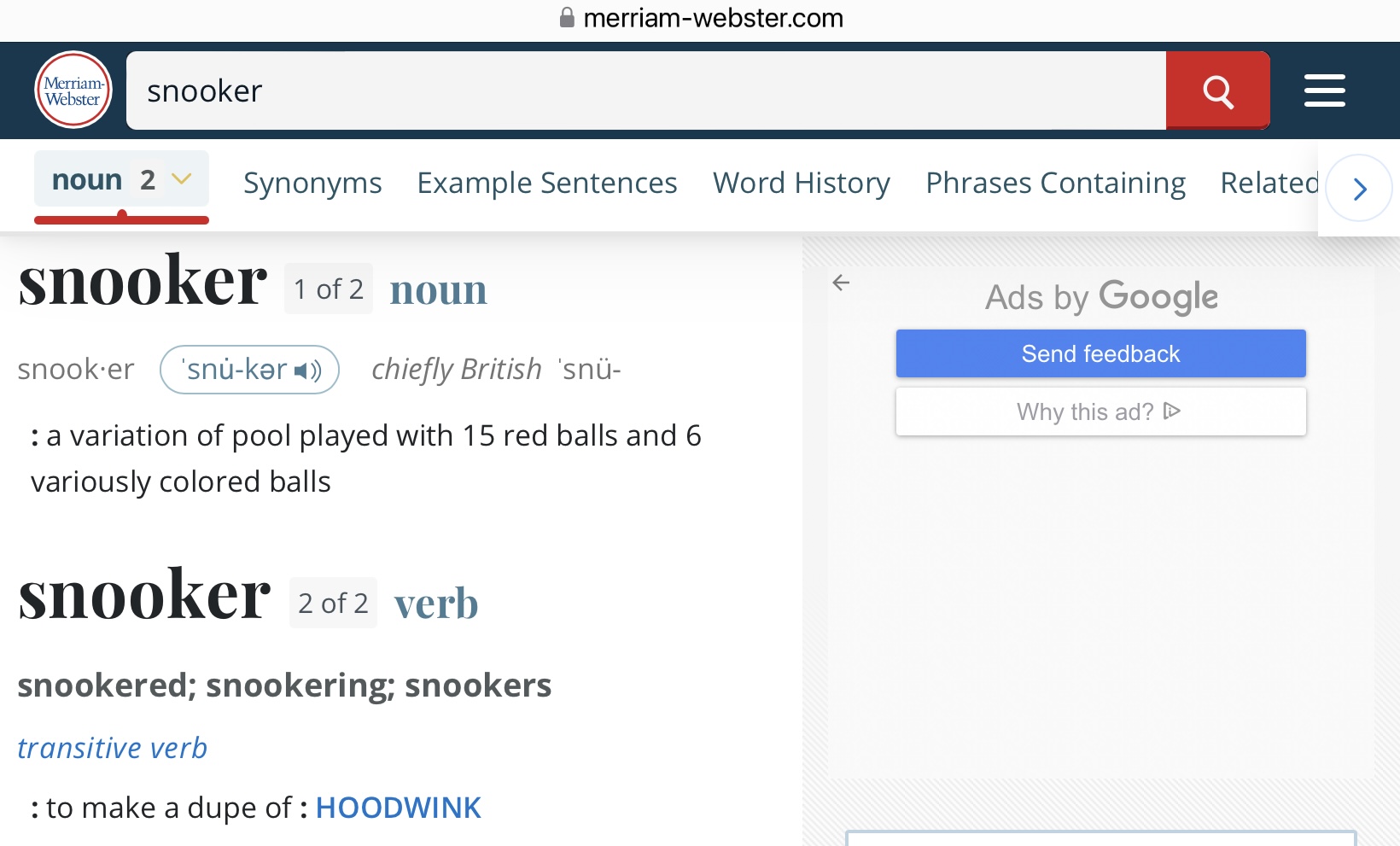
Here’s the official definition by Merriam-Webster. Click to enlarge the images.

The transitive verb describes what has befallen our City Council.

And a lesson can be learned from the noun definition.

Don’t be snookered on your Christmas gift purchase of professional snooker balls. You can get them for less than the full retail price of $452.03.

Balderdash And Poppycock – Austin Energy’s Convoluted Presentation To The City Council

By Bill Oakey, November 29, 2022

To the untrained ear, Austin Energy’s presentation to the City Council this afternoon would sound very convincing. It had all of the slickness of a clever, seasoned used car salesman. But if you kick the tires, even just a little bit, those nagging flaws start spewing out like a noxious cloud of dust.

Here Is a Quick Breakdown:

1. The positive year-end revenue balance was offset by the negative impact of not getting paid for the sale of Austin Energy’s old headquarters at Town Lake Center.

Reality Check – They could have delayed some planned expenses until this fiscal year, when they will get paid for that building. (Duh)! Regardless of what they wanted to do with the un-budgeted summer revenue surplus, they should have requested a budget amendment approval from the City Council. Then, the lengthy explanation made this afternoon would not have been necessary. Transparency, anyone?

2. A dramatic increase in the monthly customer charge, and a radical upending of the rate design is necessary to “move residential ratepayers closer to “cost of service.” Right now, large users of electricity are “subsidizing” the small users.

Reality Check – All of the large electric utilities in Texas maintain a standard $10.00 customer charge. What is so strange and unique about Austin Energy that makes a high customer charge necessary? Absolutely nothing, unless you believe in balderdash and poppycock. (I used to believe I could fly, at the age of 6, when I saw Peter Pan on TV). As for the large electricity users “subsidizing” the small users, that is a policy decision established in Austin in 1981, to encourage conservation. This afternoon Austin Energy made a bold pronouncement. They arbitrarily declared that the current tiered rate structure does not incentivize conservation. Oh, really? Is that a universally accepted notion? Is there a national study to back up that capricious claim? If there is, show me!

3. Residential ratepayers are not paying their “true cost of service.” This is unfair to the commercial ratepayers.

Reality Check – That is a worn-out discussion that has crept into Austin rate cases, since Gary Hart tried to run for President in 1984. Read this blog piece for the full lowdown on that crazy issue.

Observation – The City Council today spent a great deal of time talking about the low-income CAP Program. This is an important program, and it should be strengthened if we have a rate increase. But Austin Energy has planted the notion that they are the only citizens who will suffer from a triple dose of rate shock. Renters, seniors and property taxpayers of several income levels deserve a seat at this table!

Conclusion – No other utility in Central Texas has asked for a base rate increase. San Antonio returned nearly $50 million to their ratepayers from the summer surplus. These utilities have obviously done better planning and better financial management, with better oversight.

Warning – If you believe that three doses of rate shock will only cost you perhaps $30.00 per month, good luck if you live in a 3 bedroom house. Your bill increase during several months each year will be much higher. Unless you carry a fan in each hand, and keep your thermostat above 80 degrees.