Tag Archives: Austin affordability

Soccer Stadium On City Parkland Would Require Public Vote

By Bill Oakey – November 9, 2017

A resolution at today’s City Council meeting seeks to identify sites, including City parkland, that could be used for a major league soccer stadium. We should hope they are aware that the City Charter requires a public vote before City parkland could be put to such a commercial use.

This topic came up a few years ago when two commercial golf courses were being seriously considered for Walter E. Long Metropolitan Park. A contract was prepared and the City still has a webpage describing that contract. But entering into that contract would have been a clear violation of the Charter, without a public vote. And there is a new golf course proposal in the latest Colony Park master planned community project.

Here is the section of the City Charter that applies:

Article II, Section 7

All powers and authority which are expressly or impliedly conferred on or possessed by the city shall be vested in and exercised by the council; provided, however, that the council shall have no power to, and shall not:

(A) Sell, convey, lease, mortgage, or otherwise alienate any land which is now, or shall hereafter be, dedicated for park purposes, unless:

(1) the qualified voters of the city shall authorize such act by adopting in a general or special election a proposition submitting the question and setting forth the terms and conditions under which such sale, conveyance, lease, mortgage, or other alienation is to be made

The 2015 golf course contract was described as a “license agreement.” Using that language is a lawyer-ly trick to try to get around the Charter. If the term “license agreement” was used to circumvent the prohibition against leases, surely it falls within “otherwise alienate” and would be clearly prohibited under both the letter and the intent of the Charter.

In November 2000, the City did hold a required election to decide whether to put a hotel and golf course at Walter E. Long Park. See the two articles below:

1. Austin Chronicle – March 24, 2000: https://www.austinchronicle.com/news/2000-03-24/76535/

2. 2000 Election Results, Austin Chronicle – November 10, 2000: https://www.austinchronicle.com/news/2000-11-10/79348/

The Charter Provision Dates Back to December 9, 1952

At 10:00 AM on that date, Mayor Bill Drake and the City Council held a meeting and voted to put Proposition 6 on the ballot. The parkland provision was included as Article II, Section 4. (a). In the election on January 31, 1953, it passed by a 61% margin  (Click to enlarge picture).

The history archives show that there was plenty of lively debate throughout the city surrounding this round of charter amendments. It was a complete overhaul. Emma Long, Austin’s first female council member, was a major force behind the charter revisions. Today a huge precedent is at stake.  A new 2018 Charter Review Commission is hard at work planning for an election next year. If you served on that commission, you might get stars in your eyes thinking of your contribution to the City. But what if your efforts got approved by the voters, only to be tossed aside by City officials in the future?  We should respect our legacy and vigorously defend our Charter.

Quick Musical Note:

The number one song on the day of the 1953 election was “Don’t Let the Stars Get In Your Eyes” by Perry Como.

Austin Mayor Bill Drake dressed as Santa Claus – From The Portal to Texas History
Music Community Needs Access To City’s “Secret List”

By Bill Oakey – November 8, 2017

Where is The List? Who has it, and why are they hiding it?

On Wednesday the Austin Monitor reported that the Austin Music Commission is seeking a list of the City’s unused publicly owned properties. The commissioners are looking for help in relocating Austin’s music venues, which have been falling like dominoes in recent years, due to gentrification. Folks in creative arts groups like Music People and the Austin Creative Alliance have been asking for the elusive list since at least 2011. But their repeated requests through City staff at public meetings and other avenues have gone unanswered.

The arts organizations, music venue owners and local musicians are all hoping that their City, which calls itself the “Live Music Capital of the World” will open up some unused public land. They would like access to some of it for music events and other creative arts activities. Austin has an office called the Music and Entertainment Division, which has been trying since this past February to get The List from the Real Estate Services Division. After a recent followup request, the real estate office said that their inventory of City property, does not contain a breakdown of which parcels are unused or idle.

This is another one of those cases where citizens, commission members, City staff and even City Council members have been kept in the dark on access to public information. Since the buck needs to stop somewhere, whaddaya say we try to stop it right here on this blog! I will fill out a public information request. I’ll take it to City Hall and plop it down on the desk in whichever office I am directed to. Then we’ll see what happens.

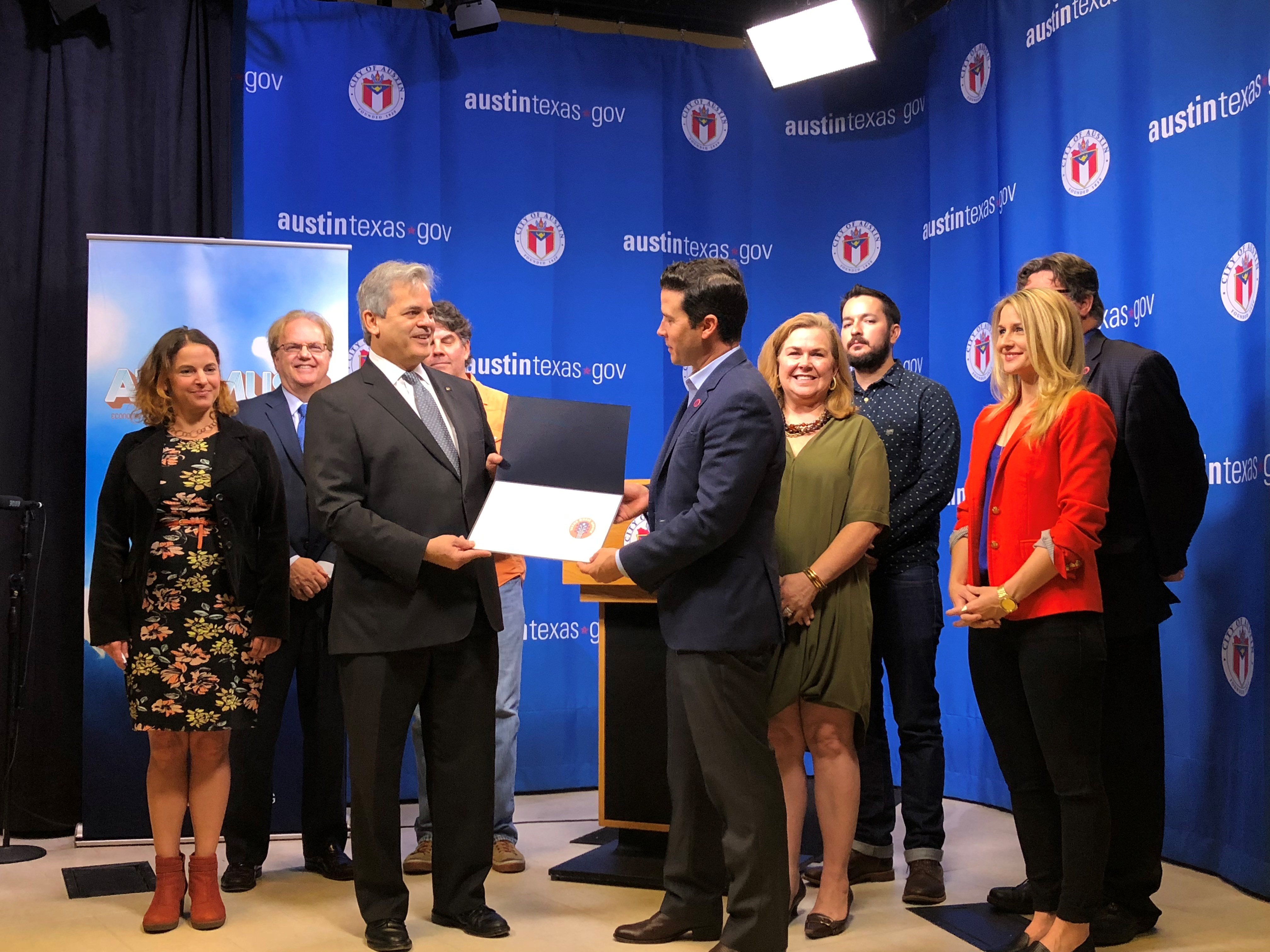
The timing for the unmasking of The List is actually pretty good right now. Just two days ago, the  City’s Economic Development Dept. held a press event announcing that the Governor’s Texas Music Office has designated Austin as an official “Music Friendly City.” Mayor Steve Adler summed up the affordability situation quite eloquently by saying, “The Live Music Capital of the World should be a city where the local music industry thrives and expands, and a city where artists and musicians can afford to live and create. But we’re not going to be the Live Music Capital of the World for much longer if we keep losing musicians and live music venues. That’s the challenge we face, and it’s the challenge we will meet.”

Mayor Adler Receives “Music Friendly City” certificate

If you would like the City to finally compile and release The List, please click here. You can send a single email to all 11 City Council members. If I or anyone else I hear about lands a copy of it, I will be pleased to publish it on this blog.

I moved to Austin in 1971 in large part because of the live music scene. Back in the old days of the mid-1970’s I booked bands into nightclubs part-time. One of them was a western swing band with a funny name called Asleep at the Wheel. I booked their first Austin gig at the Cherry Street Inn on Guadalupe in November 1973 (Now the Clay Pit Restaurant). To experience the best that Austin has to offer these days, check out Sarah Sharp at the Elephant Room at 315 Congress Ave. every Tuesday evening from 6:00 – 8:00.

Musical Accompaniment for This Blog Piece:

“The List” – Album by Rosanne Cash. Classic songs handed down to her by her dad, Johnny Cash

  1. “Miss the Mississippi and You”
  2. “Motherless Children”
  3. “Sea of Heartbreak”
  4. “Take These Chains From My Heart”
  5. “I’m Movin’ On”
  6. “Heartaches By the Number”
  7. “500 Miles”
  8. “Long Black Veil”
  9. “She’s Got You”
  10. “Girl From the North Country”
  11. “Silver Wings”
  12. “Bury Me Under the Weeping Willow”
  13. Rosanne Cash talks about “The List”

County Judge Sarah Eckhardt Steps Forward To “Go Big” On Affordability

By Bill Oakey – November 6, 2017

What a difference a day makes! Last Thursday was like any other day for the last several months. I had begun to wonder what happened to affordability. Nobody at City Hall or Travis County seemed to be talking about it any more. Was it even worth it to keep this blog going?

Then I walked into my Friday morning appointment with County Judge Sarah Eckhardt, who was joined by her chief of staff, Peter Einhorn. I made a really bold suggestion, thinking at the very least that it couldn’t hurt to try. I told her that the numbers are there to prove that we are facing an “affordability perfect storm” And that the only way to stop it would be to launch a major initiative. We would have to go big!

My recommendation is a joint effort by the City and the County, every bit as ambitious as the City’s highly publicized “Year of Mobility” last year.  In my presentation to Judge Eckhardt, I suggested that the issue could be approached on two basic fronts:

  1. Conduct a “Pre-Mortem.” We need to assemble the data to show that we are on a cost spiral that is absolutely unsustainable. Our local taxes, spending and debt are accelerating at a dizzying pace. Because of our dubious distinction as the most economically segregated region in the United States, we need to shift course before it’s too late. A pre-mortem is simply the opposite of a post-modem. Let’s be proactive and solve the problem now, instead of asking what went wrong after the fact. Think of a chart in front of you that shows what your taxes might look like in five years and again in ten years, at the current rate of acceleration. How much debt would our local governments have? How bad would AISD taxes be without any reform of the Robin Hood funding formulas? What would average home appraisals be? What would our median family income look like with our current mix of jobs and wages? I contend that this analysis would show that we are headed for an affordability cliff. Unless steps are taken to turn the situation around.
  2. Now for the next step. A lot of very competent people have studied and spoken about affordability. In the last few years, we have heard many great speeches, attended lots of meetings and forums, and walked away with fancy reports tucked under our arms. But after the presenters turn out the lights and send us home, what happens to those reports? Far too often, nothing much. They languish on shelves like lazy cats…

The challenge to Judge Eckhardt last Friday was to see if she would spearhead an effort to turn those affordability reports and committee proposals into concrete action. With a formalized plan and timeline. I suggested that if she would take the lead, others would follow. The exciting news is that she enthusiastically embraced the challenge. “We will get the reports off the shelves,” she insisted. “There will be rules of engagement that will not only look good, they will do good.” We talked about forging ahead with a can-do spirit. And now she is ready to try to make it happen.

Travis County Judge Sarah Eckhardt

Sarah Eckhardt possesses the tenacity and the smarts to tackle a big project by focusing on the broad objectives, and then drilling down to the finest details. In our meeting, she rattled off several examples of ways to implement cost-saving and efficiency measures. Her approach includes protecting seniors, workforce development, affordable housing and many other areas. She would like to exchange ideas, not only with the City of Austin, but with other cities and counties. And she’s willing to confront the State Legislature about what they need to do to help. Here’s hoping that Austin city officials will come on board and allocate the time and resources necessary to deliver some solid results on affordability. It is time for everyone to wake up and spring into action!


Musical Accompaniment for This Blog Piece

  1. “What a Difference a Day Makes” – Dinah Washington
  2. “A Little Less Conversation” – Elvis Presley (selected by Sarah Eckhardt)
  3. “Where the Action Is” – Freddy Cannon
  4. “Cat’s In the Cradle” – Harry Chapin
  5. “All the Cats Join In” – Teresa Doyle
  6. “Where You Lead” – Carole King
  7. “I Will Follow You” – Ricky Nelson
  8. “Stand and Deliver” – Adam & the Ants

New Central Library Has Highest Parking Fees In Texas

By Bill Oakey – November 3, 2017

You owe it to yourself to check out the new Central Library. It is a fabulous showcase, so much more than just a library. There is an art gallery, gift shop, restaurant and rooftop garden. Plus several event spaces available for rent. The views from the building are stunning, and the atmosphere is unlike any library you’ve  ever seen in a library.

But there is just one problem…It’s that horribly ugly thing called parking. Fortunately, the first 30 minutes are free. So, it won’t cost you anything to drop off some books or pick up books that you placed on hold. But the clock will be ticking and here’s how the parking fees will add up:

From 31 minute up to an hour – $3.00
Over 1 hour, up to 2 hours = $5.00
Over 2 hours, up to 7 hours = $7.00
Over 7 hours, up to 10 hours = $9.00
The peak is $30.00 for over 12 hours. If you fall asleep for that long, you probably deserve to be charged that much!

How Much Do Other Cities Charge for Central Library Parking?

  1. In San Antonio, parking is free for up to 3 hours.
  2. In Dallas, parking is free for the first 15 minutes, then it’s $.75 per hour for the next two hours.
  3. In Fort Worth, parking is free for 2 1/2 hours.
  4. Houston charges $2.00 per hour, but surely we can do anything better than Houston!
  5. Even Los Angeles only charges $1.00 for the first hour and a flat rate of $1.00 after 3:00 PM on weekdays and all day Saturday and Sunday.

Stay Tuned…

I have been in touch with library officials and several members of the City Council. This battle looks like it might be winnable. Keep your fingers crossed! In the meantime, you should go down there and check out this amazing facility.

Read Kylie McGivern’s KXAN news report on Central Library parking here.

Musical Accompaniment for This Blog Piece:

  1. “My Heart Is An Open Book” – Carl Dobkins, Jr.
  2. “You Can’t Judge a Book By Its Cover” – Bo Diddley
  3. “Book of Love” – The Monotones
  4. “I Could Write a Book” – Peggy Lee
  5. “Fun Fun Fun” – The Beach Boys (rare stereo version)

Questions About The New I-35 Proposal That Need Answers

By Bill Oakey – November 2, 2017

The new “Capital Express” proposal to improve I-35 may be the most important Austin transportation initiative in our lifetime. To not “get it right” would be a monumental mistake. Every local official has a big stake in the process. I believe that the City and Travis County should review the proposal, consider it carefully, and get clear, detailed answers to several very serious questions.

TxDot’s initial announcement to the media was severely lacking in the most basic, common-sense details that almost any citizen would want to know. As a result, the public reaction in comments to the American-Statesman and other forums ranges from skepticism to outright condemnation. The announcement was a major public relations disaster.

Here is a list of questions that I am asking our local officials to pose to TxDot and the principal players who developed the proposal. Of course I respect the fact that they may have additional questions of their own.

These Are Very Basic Questions

1. If the highway will not be made any wider, how would the proposal add vehicle capacity?

2. Does the plan add new lanes by making all lanes narrower, as was done on MoPac?

3. What will be the total number of lanes in each direction?

4. If the upper deck from MLK to Airport Blvd. is eliminated, wouldn’t that by itself result in a net loss of vehicle capacity?

5. Why not keep the upper deck and preserve that vehicle capacity?

6. What is the total number of lane-miles on I-35 today vs. total lane-miles under the Capital Express proposal?

7. What is the net gain or net loss in free lane-miles?

8. Why not have just two managed toll lanes instead of four?

9. Starting from this year’s vehicle load, how many additional vehicles are projected to be using I-35 over the next 10 or 15 years? And does the Capital Express Proposal meet that need?

10. Are there any maps, sketches or diagrams that show a net gain in lane capacity under the proposal?

11. Are there any other metrics known today or being planned that would provide additional assurance that this proposal will in fact relieve traffic congestion along the Austin portion of I-35?

Please understand that the $8 billion price tag, combined with the unpopular notion of more toll lanes begs for the clearest possible explanation to the public as to why this plan is the best plan that could have been devised.

City Council Should Obey City Charter In Planning Commission Disupute

By Bill Oakey – November 1, 2017

Should it take action by our district attorney or a nasty, expensive lawsuit to entice our grassroots City Council to obey the City Charter? After all 11 of them swore to uphold the law when they took their oath of office, shouldn’t we be able to trust them to keep that oath?

This week the NAACP and the citizens’ group, Community Not Commodity filed a complaint with the District Attorney, asking her to investigate the City Council’s failure to appoint members of the Planning Commission in accordance with the requirements of the City Charter. Today the Planning Commission is heavily stacked with special interests who have ties to developers and real estate. They comprise seven of the thirteen seats, which is a majority.

Article X, Section 2 of the City Charter requires that two-thirds of the Planning Commission “shall be lay members not directly or indirectly connected with real estate and land development.” That language was part of a Charter amendment ballot proposition approved by the voters in 1994. Here we are in 2017, and there’s no telling how many Planning Commission decisions have been made over the past 23 years by unlawfully constituted commissions.

Speaking of elections, several members of the City Council will be up for reelection next year. Some of them are already gearing up for their campaigns. Right now they have a couple of choices. They could fight against the City Charter with the District Attorney or later on in a courtroom. Or, they could avoid that whole mess by simply contacting District Attorney, Margaret Moore and telling her that they will abide by the City Charter and change the membership of the Planning Commission.

Does the City Have Lawyers Lurking in the Shadows?

To most of you reading this, the language in the Charter probably seems pretty clear. What part of the two-thirds membership requirement is there not to understand? What part of the spirit of that requirement is there not to understand? Well, back in the 90’s when that Charter Amendment was adopted, Bill Clinton was President. One of his many talents was his lawyer-ly ability to parse words. Wasn’t he the one who argued that “It depends upon what the meaning of the word “is” is?” (Here it “is” on YouTube).

I suppose the City could have a gang of lawyers, lying awake at night trying to parse their way out of our voter-approved City Charter amendment. I looked it over carefully, and the word “is” does not appear in that section. But I found another word that could be just as vexing, if not more so. Maybe those lawyers have stumbled upon it too. If so, let’s try to head them off at the pass.

Notice the word “shall” in the all-important phrase, “shall be lay members not directly or indirectly connected with real estate and land development.” Could “shall” be the word being groomed for creative parsing? If that’s the case folks, then I have some pretty bad news. But let’s take the good news first. Here is the definition of “shall” in the Merriam-Webster dictionary:

shall

2b. used in laws, regulations, or directives to express what is mandatory

That looks pretty solid. But are you ready for the bad news? In lawyer-land, words can be stretched, bent, twisted and parsed. So in the not-too-distant future, our tax dollars could be paying for a courtroom drama centered around the planning commission composition contention. And, yes, it could all come down to that terribly intimidating and confusing word, “shall.” Check out this definition from Black’s Law Dictionary, 2nd Edition:

shall

As used in statutes and similar instruments, this word is generally imperative or mandatory; but it may be construed as merely permissive or directory, (as equivalent to “may,”) to carry out the legislative intention and In cases where no right or benefit to any one depends on its being taken in the imperative sense, and where no public or private right is impaired by its interpretation in the other sense. Also, as against the government, “shall” is to be construed as “may,” unless a contrary intention is manifest. See Wheeler v. Chicago, 24 111. 105, 76 Am. Dec. 736; People v. Chicago Sanitary Dist., 184 111. 597, 56 N. E. 9.”.:;: Madison v. Daley (C. C.) 58 Fed. 753; Cairo & F. R. Co. v. Ilecht, 95 U. S. 170, 24 L. Ed. 423. SHAM PLEA. See PLEA. SHARE 1082 SHERIFF

Here’s What You Can Do to Stop the Foolishness and Support the Voter-Approved Charter Amendment

You can send an email to the Mayor and all of the City Council members with a single click. Just click here. Ask them to settle the case now, accept the literal word and the spirit of the City Charter and appoint some new and appropriate members to the Planning Commission.

Musical Accompaniment for This Blog Piece:

  1. “We Shall Overcome” – Mahalia Jackson
  2. “Is You Is Or Is You Ain’t My Baby” – Louis Jordan or Dinah Washington
  3. “I Fought the Law” – The Bobby Fuller Four or The Crickets (without Buddy Holly)
  4. “Bend Me, Shape Me” – The American Breed
  5. “Twistin’ the Night Away” – Sam Cooke
  6. “Words” – The Bee Gees

Does Austin Really Have “Affordable Housing?” – And If So, Where Is It?

By Bill Oakey – October 28, 2017

Once upon a time, a little girl named Dorothy took a walk with her friends, the scarecrow, the tin man and the cowardly lion. They had been told there was a wizard in Emerald City and they were off to see him. Here in Austin, some folks have tried a similar quest along a different yellow brick road. They are in search of something popularly referred to as “affordable housing.”

So, just this morning, I called a City Council office and asked what I hoped would be a simple set of questions. Here they are:

  1. How many agreements has the City made with developers over the last 20 years to allow density bonuses or other types of waivers and exemptions in exchange for the promise of “affordable housing” units?
  2. Does the City maintain a database of these agreements, with the addresses of the properties, the number of “affordable units” promised and the criteria used to define those units as “affordable?”
  3. Over those 20 years of so, were procedures put in place to monitor each of those approved agreements to ensure that the affordable units actually got built, and were actually marketed at the agreed upon prices?
  4. Did each of those agreements include fines or other penalties for failure to adhere to them?
  5. Were followup actions taken in every case, to ensure that the agreements were fully enforced, and all applicable fines or penalties assessed and collected?
  6. Did each of these agreements contain language that required the units to remain affordable  into the future, after the sales to subsequent owners or the turnover of tenants?
  7. How many units in each of these approved development projects or subdivisions exist today within each project covered by these agreements?
  8. Is there a public webpage or a City office where citizens can go to find a list of these affordable units currently on the market for lease or for sale?

Are You Ready for the Answer That I Got?

I cannot reveal the name of the Council Aide that I posed these questions to. He is one of the very best of the bunch, and he gave me the only answer he could. What he said was…

“Those are all very good questions!”

While you are reading this, jack hammers, drills and buzz saws are pounding and whirring away in all quadrants of the city. Huge and controversial developments are now being built, with everyone who participated in the approval process tucking themselves into bed every night, believing that some of those new units will become “affordable.”

But does anybody know if that will really happen? How would we ever find out? Will any of the folks who pack their baskets and bring along their dogs for a journey down the yellow brick road ever get to the affordable pot of gold at the end of the proverbial rainbow? Or will they simply click their heels together and wake up to find that it was all just a whimsical dream?

Stay Tuned, Because This Blog Posting Is Going to the City Council

This may be one of those situations where if nobody knows the answer, then there is no answer. If that’s the case, I will be making a formal proposal to put in place the procedures that are outlined in my questions.

The Race Is On!

While you are reading this, developers, developer lawyers, lobbyists and engineers, etc. are very hard at work. The mad scramble is on to push for a speedy conclusion to the CodeNext final approval. Imagine a hundred thousand race cars on a giant track in the sky above Austin. There is a great golden starting gate and a humongous cannon set to go off to start the race. At precisely one second past midnight on CodeNext’s start date, the cannon will blow. Then every square inch of land within a zillion miles of the center of Austin will get a proposal for a new development project. A hundred thousand motors will roar to life in a hundred thousand bulldozers. HIgh above the sprawling streets in cities around the world, from Austin to Boston, from Dallas to Dubai, the champagne corks will explode in bankers’ and developers’ offices.

And somewhere in Austin, off on a grassy hill along one of the many corridors slated for new development, a little tiny mouse will whisper to the other little tiny mouse crouched next to him…

“Wasn’t there supposed to be something in CodeNext about affordable housing?” And the other mouse will reply, “Yes, I read that same story. Did you hear the one about Wendy and the Lost Boys? She can make them fly! Just by sprinkling pixie dust. Maybe we can fly too, and be like Peter Pan!”

Musical Accompaniment for this blog piece:

  1. “The Race Is On” by George Jones
  2. “Over the Rainbow” by Judy Garland
  3. “We’re Off to See the Wizard” by the Munchkins
  4. “(Such An) Easy Question” by Elvis Presley
  5. “Answer Me My Love” by Nat King Cole

CodeNext Songs

  1. “Who Will the Next Fool Be?” by Charlie Rich
  2. “Next Door to An Angel” by Neil Sedaka
  3. “Before the Next Teardrop Falls” by Freddy Fender
  4. “The Next Time” by Cliff Richard
  5. “Next In Line” by Conway Twitty

A New Transportation Vision for Austin

By Bill Oakey, May 4, 2017

Close your eyes and picture yourself driving to work on a crowded Austin roadway. Think about all of the cars that you see around you and every one that goes by.  Then ask yourself one simple question. How many people do you see in each one of those cars?  The answer is just as simple…

ONE!

So, the key to solving Austin’s traffic dilemma is to finally find a way to get more people into fewer vehicles on the daily commute to and from their workplace.  Capital Metro is our only current mass transit provider. Unfortunately, their model is a very outdated and severely limited centralized bus system. Their new 2025 plan is all about continuing this model, and even making mass transit more limited for the people who don’t live near a centralized corridor.

This old-fashioned model works well in a small compact city, with nearly all neighborhoods located close to the center of the city. But Austin has long since outgrown that model with untold numbers of residents living well beyond the narrow boundaries served by Capital Metro. To make matters worse, their consultant-inspired 2025 plan actually eliminates many popular routes used by people who live less than a couple of miles from downtown. One of the bus routes slated for elimination is the #21/22 Exposition bus that serves Tarrytown. The entire neighborhood is in an uproar. We are at the mercy of the Capital Metro board, who probably never even ride their own buses.

So, What Is a Better Solution for Commuter Transit?

My proposal would probably require a big push from both the City of Austin and Travis County to get Capital Metro to implement a new decentralized model that would serve neighborhoods without any current bus routes. The plan calls for a variety of vehicle types to be dispatched to neighborhoods throughout the City and County every weekday. Here are the elements of the proposal:

  1.  Capital Metro should solicit input from medium to large-scale Austin employers to determine which of their workers would like to use the service, and what their addresses are. Then, routes would be determined throughout the greater Austin area, based on where people live and where they work.
  2. Vehicles of different sizes, ranging from cars to vans to buses, would be dispatched to take the commuters to and from work every day.
  3. A team of planners could work out the details on how to set up this new system. Employers could help with some of the cost of the service. And the rates for the passengers could be determined as well.
  4. Capital Metro could still operate a Central City bus system. But pouring every dollar of their available money into expanding that model would only help a small percentage of the people who need mass transit.

Some may ask, what about the light rail option? Realistically, it is probably too late for Austin to build a major rail system. The first $1 billion leg that failed in the 2014 bond election would have doubled our general obligation debt. Taxpayers are not likely to support the $12 billion to $15 or $20 billion cost of a citywide rail system. We missed our chance, unfortunately. It might have been possible if we had started it before 2000.

The sort of comprehensive approach that I suggest would make a major dent in the number of cars on the roads every day during morning evening rush periods. To play devil’s advocate, someone might ask how Capital Metro could employ drivers who only have two pickups per day on these routes. The answer to that question is simple. We live in an age of transportation networking. The large pool of TNC drivers could participate in this new system. They would have to be allowed to drive for this new service, in addition to their work with the TNC’s.

Of course, a system such as this would be a sea change for Capital Metro. It would totally disrupt their current plans and their projected annual budgets. But I strongly believe that we need an innovative approach to solving our transportation problems. We can’t build roads fast enough to accommodate all of the people. And the prevailing push for more and more toll roads is becoming ridiculously expensive, even to think about, much less for anybody to pay for. We have a broken system that needs public support for real improvement. If it turns out that Capital Metro cannot be convinced to embrace the type of change that is needed, then perhaps they should be dissolved, and a new transportation entity should be created to take their place. An early 1900’s model simply will not serve the needs of a growing 21st century city like Austin.


Affordability Proposals That Will Really Make A Difference

By Bill Oakey – March 1, 2017

Even though it is commonly accepted that Austin has a serious affordability problem, there are some who do not believe City officials are taking the matter seriously. A recent newspaper article even used the word “affordability” with quotation marks around it. I believe it is well past time to get very serious about it and permanently remove the quotation marks.

Here is a set of proposals that will make a real difference in the lives of many Austinites:

1. Work With Area Businesses to Raise the Minimum Wage

The City does not have the legal authority to require businesses to raise the minimum wage. But they could certainly call business leaders together and work to make it happen. In January, 19 states raised their minimum wage. Major cities, such as St. Louis, Baltimore and many others  have either raised it or are scheduling votes to do so. Many of those plans call for a phased-in approach to reach a certain wage target between now a some future date.

Here in Austin, low-wage workers have struggled for the past several years to stay afloat amidst appalling rent increases and stagnant wages. It is time for somebody to step up to the plate and call for a voluntary agreement to phase in increases to the minimum wage. Downtown business leaders are not going to do this on their own. It will take a major leadership push on the part of City officials and labor advocates, as well as grassroots citizen involvement.

We always hear the same arguments against raising the minimum wage – It will put people out of work, it will cut workers’ hours, etc., etc. And yet, whenever the Federal government has raised the minimum wage in the past, businesses somehow survived and people kept working. What is terribly galling in all this is that businesses will gladly pay for increases in rent, utilities, furniture, supplies and everything else you can think of…except the very people who keep their businesses running and serve their customers.

2. Set Priorities On Austin’s $8.3 Billion Set of Costly, Ambitious Plans

Last year on this blog, I asked several time for a complete listing of all of the plans across the City’s entire spectrum of departments.  Finally, during last summer’s budget discussions, Council Member Ellen Troxclair asked for a list of plans and the costs for each one of them.

 Here is the list of plans. If you put these plans and costs into a spreadsheet and total them up, the price tag comes to a staggering $8.3 Billion! And keep in mind that several of these items only show annual costs, without saying how many years it will take to complete them. So, the real total is considerably higher than $8 billion. And the plans keep coming. Another one was probably started while you were reading this!

The City needs to publish a complete list of plans in a single printed volume and also post them on their website. We need to have a major public discussion on prioritizing these plans. There is no way we could afford to pay upfront or borrow anything close to $8 billion dollars anytime soon. It would be irresponsible for the City to continue writing and developing any more plans until they can come up with an affordable timeline to pay for the ones we already have.

3. Allow People 65 and Over to Opt Out of the New Composting Fee

Sometime during the past year, some person or persons on the City staff woke up one morning with a brilliant idea…Let’s start charging every utility customer a brand new $5.00 composting fee! Hey, why not? It’s only money, and it would sure make Austin look green, cool, and hip! Well, in case you haven’t noticed the “add-on fees” that are tacked onto our monthly utility bills are growing faster than the annual increases in property taxes. You can look up the annual budgets online and see this disturbing trend. The new composting fee is scheduled to be phased in, and there is currently no opt-out provision. Seniors are already overburdened with skyrocketing taxes year and year and many of us are living on fixed incomes. An opt-out for seniors on the composting fee is a very reasonable request.

4. Establish a Two-Year Freeze On Utility Bill “Add-On Fees”

For almost 150 years, the City of Austin paid for all of its service from property taxes, sales taxes and transfers from the Austin Energy and the Water Utility to the General Fund. Then, a creeping trend began to evolve. Some bureaucrats decided to add things like a drainage fee, transportation fee and “clean community service” fee to our utility bills. These fees are rarely discussed in detail during budget season, but they have been rising at an alarming rate in recent years. The City Council should order a freeze on increases to these fees for two years and direct the staff to come up with efficiency plans to control the spiraling costs.

5. Set Policies to Protect Austin’s Remaining Affordable Neighborhoods

Austin is far from being the first city to face an affordability crisis. San Francisco, Portland, Seattle and other cities have faced the same issues of gentrification and displacement that we have. It is time for our City officials to reach out to these other cities and collaborate with them to determine what policies can be put into place to save some of our older neighborhoods before it is too late. We have heard lots of talk about traffic impacts and neighborhood preservation. But where are the proactive strategies to ensure that we don’t continue to lose every square inch of Austin land to luxury retail and extremely dense residential development?

We already have plans and reports that claim to include these protections. And yet we watch as communities in East Austin and along South Congress and other areas fall prey to the greedy whims of outside profiteers. To them, Austin is just another page in their ledger book. If our economy collapses under the weight of wage stagnation and economic inequality, then it’s no problem for the profiteers. They can just move on to wherever the next “It City” happens to be. And Austerities will be stuck with the massive debt hangover that comes with another boom and bust cycle.

If the City wants to get serious about affordability, our leaders will approach the problems of wage stagnation, displacement of older residents and enforceable standards for neighborhood traffic and land use compatibility. There should be plenty of examples to follow from other cities that have stumbled along the same treacherous path that we find ourselves on today. We should all call upon our City Council to take the quotation marks off “affordability” and get to work on some serious, meaningful solutions.

Three Words To Improve Austin Traffic – Hard Capacity Caps

By Bill Oakey – January 26, 2017

Traffic congestion and affordability go hand in hand, because building and improving roads is very expensive. Many Austerities swallowed hard when they voted “Yes” on last November’s whopping $720 mobility bond proposition. It was an audacious and very precarious leap of faith that all that money would indeed lead to meaningful traffic relief.

There were many skeptics on that question, myself included. Not all of the skeptics voiced outright opposition to the bonds, but there were wide-ranging fears that betrayed their silence. The heart of the mobility bond package was the so-called “corridor improvement plans.” These plans have been on the books for several years, and the complete picture of their purpose may not be clear to everyone in Austin.

But make no mistake about it. The corridor plans are geared much more heavily to growth enhancement prerogatives than to traffic relief for existing residents. These plans, their direction and their outcomes were crafted and influenced from beginning to end by major development interests. So, if you like your friendly neighborhood pet shops, bakeries and local handmade craft shops, be prepared to see many of them bulldozed and replaced by mountain-sized resort-style apartment “communities.”

You will be free to sell your comfortable home on its quiet tree-lined street and move into one of those ugly, imposing structures. That is, if you are wiling to write a check every month to an out-of-state landlord for anywhere between $1,500 to $2,500. It is all rent with no equity, but you will have your very own protected bike lane to ride 7 miles  to and from work in the 105 degree summer heat. The nearby homeowners who pass you in their cars will be saddened to see their property values continue to skyrocket because of the luxury accommodations that have encroached upon them.

Setting the Stage for a Series of Traffic Nightmares

People need to know that the implementation of the corridor plans is directly linked to the policy prescriptions in the ongoing CodeNext discussions. You can be sure that every developer from Austin to Boston, to New York to Dubai, and everywhere in between has been having wet dreams about every square inch of land along Austin’s roadway corridors. Knocking down those charming little shops with a lifetime of memories for Austin residents promises a whole generation of new developer profits. Step one will be the one to two-block long high rises. Step two will be the total gentrification and annihilation of existing single family areas. Each corridor and its adjoining neighborhood is already on some developer’s drawing board to become a trendy, utopian “complete community” that will be walkable and bike-able. But it will also be  ultra-luxurious, and frighteningly expensive

So, What’s Wrong With This Picture?

It’s the Traffic Impact!

Whenever a developer submits a plan for a new project, they are supposed to provide a “traffic impact analysis.” But have any of your friends ever seen a literal translation of one of those bureaucratic documents? Do they really have any real meaning or enforcement mechanisms attached to them? Undoubtedly not.

There is only one way to assure that a traffic impact analysis lends actual value to real people in real neighborhoods. And that would be for the City to determine a few simple things:

  1. How many vehicle trips per day can the roadway handle? That’s the road’s capacity.
  2. What is the current number of vehicle trips per day on that road?
  3. How many new vehicle trips per day will the proposed development generate?

If the City Transportation Department reviews those numbers and publishes them accurately and honestly, then the solution to traffic congestion becomes very simple. The developer cannot be granted more living units than the exact number that will avoid exceeding the roadway’s vehicle capacity. And how do we establish an enforcement policy along those lines? We ask the City to determine the “hard capacity caps” for each of the corridors, and simply not allow any developer to build anything that would generate traffic that exceeds those caps.

Transparency Is Key to Maintaining the Hard Capacity Caps

This is where CodeNext comes into play. It is absolutely critical that the time-honored phrase “traffic impact” when applied to the new development code be strictly and transparently defined and communicated to everyone. And it needs to be done with real numbers that are unambiguous. For example, if a roadway corridor is determined to have a capacity of X number of vehicles per day, then any proposed development must be required to generate not a single iota more traffic than that number.

Here’s the Bottom Line!

The Capacity Numbers for Each Corridor Must Be Published Online By the City. Along With the Current Number of Vehicles Per Day. And finally, Published Verification That Each Proposed Development Will Not Exceed That Capacity.

Period…