Tag Archives: Austin City Council

Kathie Tovo Is Hands Down Best Candidate In District 9!

By Bill Oakey – July 22, 2014

If you walk through District 9 and you happen upon someone sitting on the fence, help the person down off that uncomfortable perch, and over to Kathie’s side.  There is simply no comparison between the candidates. Kathie Tovo is far and away the best choice!

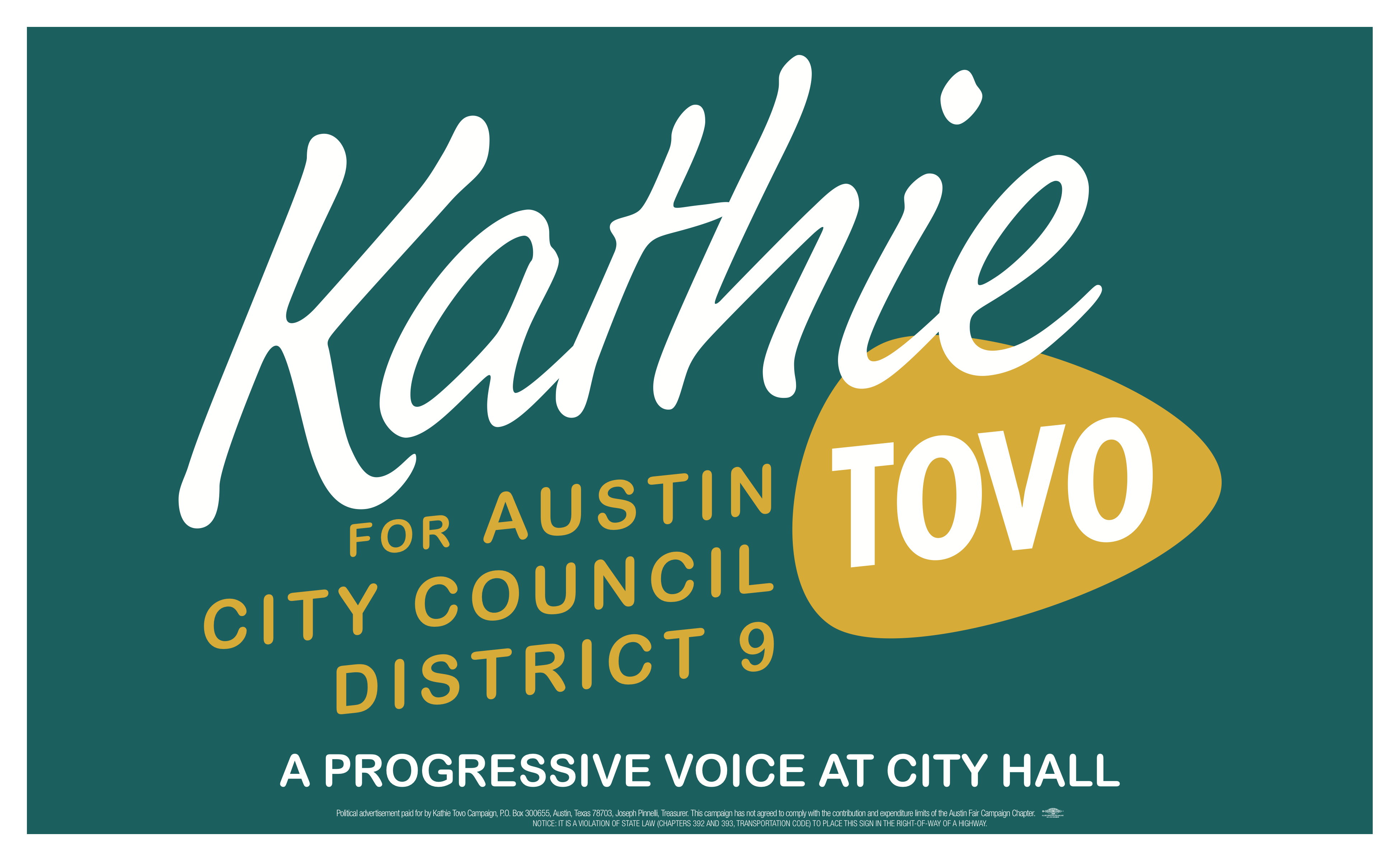
Picture

13499-Tovo-Placecard-2

The current City Council does not elicit much excitement these days, but Kathie stands out as the strongest voice for grassroots Austinites.  The special interests would love to see her defeated, but we are not going to let that happen!  While the other incumbants should be running away from their records, Kathie and her supporters have plenty of reasons to be proud of hers.  Here are just a few examples:

1. Increase to the Over-65 Homestead Exemption – Kathie and her staff did not back down in the face of initial resistance to this City Hall victory.  We won because she listened to the facts and fought to convince a majority of the Council to stand up for Austin seniors.

2. Not spending the $14 million budget surplus – While other Council members looked for ways to spend the surplus, Kathie applied her diligence to the issue and avoided any new spending.  The taxpayers scored another victory when her vote helped preserve the entire surplus.

3. A Resolution to End Costly Fee Waivers – Kathie sponsored a resolution to explore alternative funding for special event fee waivers for profitable event promoters.  The funds would come from ticket surcharges or the Hotel Occupancy Tax.  This reform would save taxpayers millions of dollars.

4. A Resolution to Consider a General Homestead Exemption – The City staff has been directed to evaluate the impact of setting up a general homestead exemption.  We are hopeful that this can happen, perhaps by phasing in the exemption over a few years.  Once again, Kathie is our champion for taking the first step in this important effort!

5. Standing Up for Neighborhoods Time After Time – Kathie understands the importance of preserving our neighborhoods and not letting them become gentrified or hobbled by inappropriate development that destroys their character.  Ask any neighborhood leader this: Who among the entire seven members of the City Council can you trust the most?  They’ll tell you it’s Kathie Tovo!

6. A Council Member and Staff That Listens to the People – As a veteran City Hall watchdog for over 30 years, I have never encountered a better working relationship with anyone on the City Council or their staff.  All of Kathie’s staff do a great job, but my special thanks go to one policy aide, Shannon Halley.  When you vote for Kathie in November, just know that you are getting not just one person, but a whole team who will do the research, listen to your concerns, and do what’s best for those of us who really care about Austin!

You can visit Kathie’s website here, and click here to make a donation.  And go here to visit her Facebook page.  Make sure that you send this blog link to all of your friends and neighbors in District 9.  When it comes to affordability, we just can’t afford to pass up the opportunity to keep Kathie Tovo.

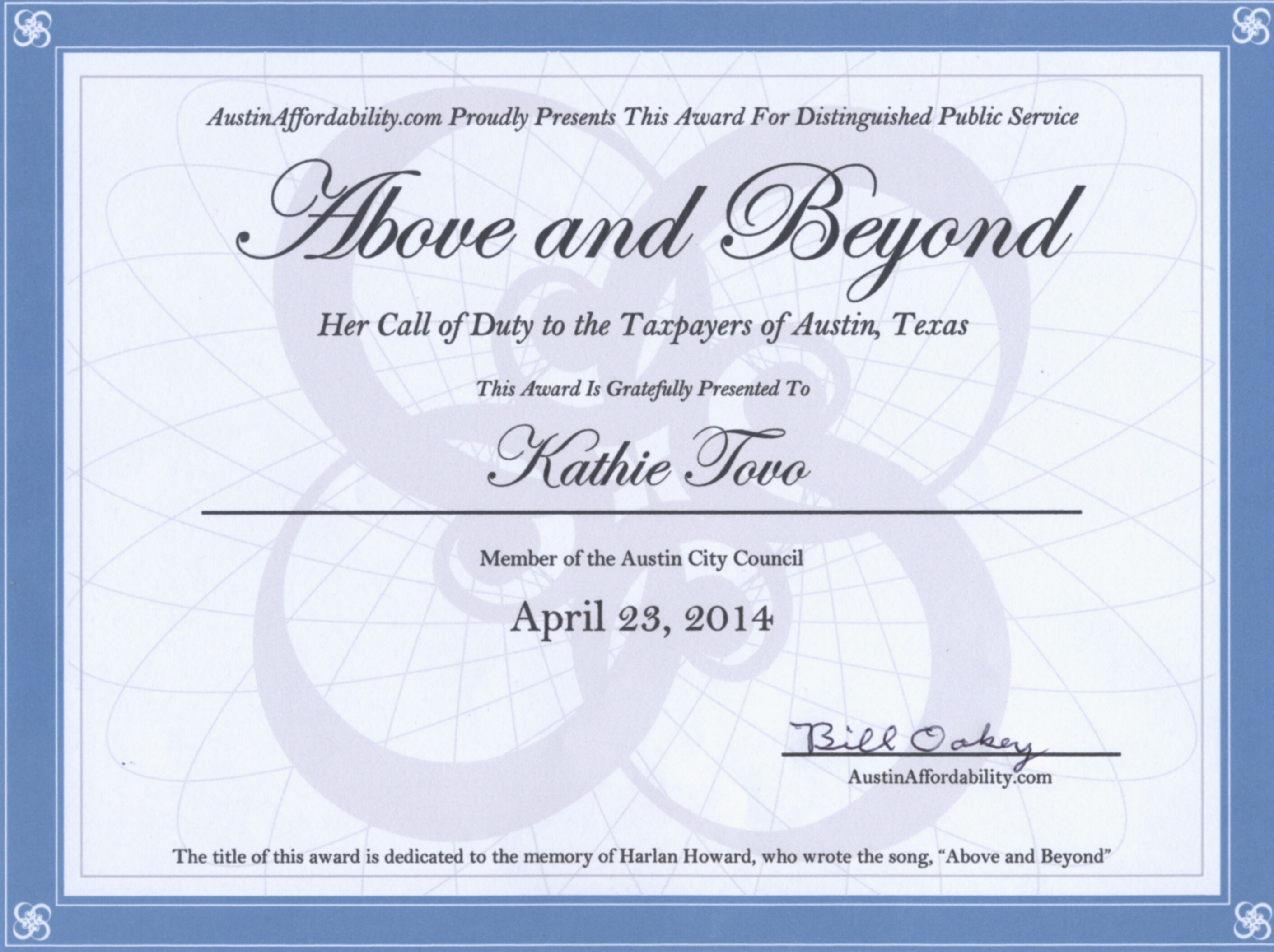
See below for the award that Kathie earned from this blog earlier this year.  Click to enlarge it.

Tovo Award

10,000 Page Views – And It’s Time To Ask For Accountability!

By Bill Oakey – July 22, 2014

This blog has now passed the 10,000 mark for page views.  That’s because here in Austin, 2014 has become the tipping point for affordability.  We can no longer afford to stand by while public officials spend our money without serious accountability reforms.  We need bold initiatives to steer us away from business as usual.

Nobody Will Tell Us How Much Money Is Left In the City Budget!

Year after year, the Austin City Council pads the City Budget with surplus funds, yet does not provide transparency for the taxpayers.  Even the Council does not track the running surplus balance because they have yet to adopt my proposal to ask the City Manager to present quarterly reports on the breakdown of surplus funds to the Audit and Finance Committee.  This blog and its followers were able to halt the spending of a $14 million surplus that was declared back in February.  And with unfilled staff vacancies representing nearly 10% of the workforce still on the books, plus sales tax and permitting fees on the rise, we have no inkling of how much surplus funds could be used to lower taxes and reduce a water rate increase.  It is time for all of us to hold them accountable!

What Can You Do to Help?

On August 5th, the City Council will hold their first work session on the budget.  Now is the time for all of us and our friends to contact them and ask for full accountability on the surplus funds in the budget.  If we leave it to the City Manager, the surplus will be quickly and quietly absorbed into new spending projects.  Let’s ask for the detailed quarterly reports on the budget surplus, and insist that the full amount be applied to lower taxes and utility rate relief.  You can contact all 7 City Council members with one click, using this link.

How to Get the Most Out of This Blog

Use these handy tools in the right hand column:

Search:  Enter a topic into this box, such as taxes, budget, City Council, etc.

Follow:  Enter your email address to receive automatic affordability updates

Vote for These City Council Candidates!:  Visit the candidate websites endorsed by this blog

Recent Posts:  Click on any of these for recent news

Categories:  Pick one of these to see all the posts in that category.  Check out “Humor” for a good laugh or stress reliever

Don’t Let Your Friends, Neighbors, and Co-Workers Miss Out on Affordability Updates

Be sure to email, tweet, and Facebook everyone on your contact lists with a link to this blog. Stay up to date on the upcoming City Council races, affordability reforms, and the need to defeat the incredibly wasteful urban rail bonds that will be on the ballot in November.

Imagine ONE Austin – Just Imagine!

By Bill Oakey – July 21, 2014

Imagine ONE Austin.  Just imagine.

No more weirdness, no more aging hippies or former flower children selling Armadillo music posters.  No more riffraff tax protestors fighting for their single family homes, quiet streets, and backyard barbecues.

Just one fully gentrified, hipster, “new urbanist” Austin.  With month-long festivals, loud all night parties and no parking anywhere.  For the rest of eternity.

But wait.  Instead of grumbling about losing the laid back, easy going, affordable Austin that we enjoyed for most of our lives, maybe it’s time to adjust our thinking. Maybe we should all join hands and embrace the changes.

So, let’s just imagine it.  Think of the pathway envisioned by the likes of the Capital Area Metropolitan Planning Organization, Project Connect, and Imagine ONE Austin. Here is a smattering of the news headlines that we can expect to see in the coming years.

January 2023 – Austin Installs Cloned City Council

Austin will begin the bright new year with a smooth transition to the new City Council.  The bold experiment to clone all seven members of the 2014 City Council and advance their ages to adulthood was a perfect laboratory success.

After eight tumultuous years with Council members elected from ten districts, America’s Chosen City will return to an era of orderly progress.  Last night, the Chamber of Commerce and the Real Estate Council of Austin presided over the swearing in of the new Council.  Austin will soon be back in business with business as usual.

“I’m ready and eager to get back on track,” Mayor Bluffingwell announced.  “I’m grateful that the people listened and they voted exactly the way we told them to.  Everyone in the room today recognizes that our namesakes made Austin a booming city.  Now we can return to predictable 5-2 votes on every critical issue.”

June 2025 – Music Concerts Cancelled at Condominium Shores

As everyone expected since the renaming of the former Auditorium Shores, the City announced today that all remaining concerts there have been cancelled.  Dogs, frisbees and kites will also be permanently banned.  Leases for high-density development have been finalized for the last 100 acres of open space.  The new revenue from the leases will allow the City to reduce property tax increases from 10% down to 9.8% for most homeowners.

Beginning this September, ACL Fest will be held in the streets, along Congress Ave. from Lady Bird Lake to the Capitol, and along East Sixth Street from I-35 all the way to Lake Austin Boulevard west to Lake Austin.

March 2026 – City Adopts New Slogan, “Keep Austin Cleared”

Today marks the start of one of the most progressive initiatives ever undertaken in Austin.  The City Council has voted to have all trees removed from the City.  The planning consultants and staff advisers have determined that trees are a serious impediment to high rises and multifamily developments.  The new slogan, “Keep Austin Cleared” will be printed on all utility bills, which will include a new “tree removal fee” until the cost to obliterate every tree in Austin is recovered.

October 2028 – Austin to Revise Land Development Code

Octopus Consulting has been hired to guide the City in a new revision of the Land Development Code.  To be dubbed CodeLAST, the new zoning system will be streamlined to generate the speediest development permits ever provided by an American city.  “We have devised a plan that will accommodate every need,” stated a spokesperson for the Real Estate Council of Austin.  “The consultants will be able to formulate it even faster than they did with CodeNEXT.”

The heart of the plan is an innovative zoning category called “Vertical Combined Use (VCU).”  It will allow developers to construct multistory towers that completely surround single family homes.  In fact, in selected neighborhoods, entire blocks could be reconfigured with interconnected structures that consume almost all of the available space.  It has been suggested that some of the old fashioned homes could be turned into tourist attractions.  Others could be demolished, and a few could remain for families eager to experience the joys of onsite community living.

February 2030 – Austin to Host Circus of the Americas

The long battle over the fate of Lions Municipal Golf Course in West Austin has finally been resolved.  The Governor and the U.T. Board of Regents announced this morning that the site will be the future home of the Circus of the Americas.  All state and local taxes for the enterprise will be waived for 25 years.

The mayor has vowed to address any logistical concerns.  He acknowledged that international guests may encounter problems with limited neighborhood street parking, but he pledged to accommodate them with 24 hour helicopter service from anywhere in the City.

Once again, Austin has landed an economic development wonder that will be the envy of the nation.  It is certain to restore the circus industry to all of its former glory.  The owners issued a statement promising to satisfy any potential critics, “It is our firm goal not to abuse the animals any more than necessary to provide a rich and rewarding entertainment experience.”

——————————————————

Imagine what a fabulous place our ONE Austin could become!

Affordable Housing Builder Hit With Tax Roadblock

By Bill Oakey – July 17, 2014

Today I got an email that really hammers home the critical problems with Austin affordable housing.  An independent builder, Eric Femrite, has been hit with high property tax appraisals that will prevent him from being able to assist the low-income renters on two of his properties.  Mr. Femrite is a dedicated affordable housing advocate.

With ten years of experience in the field, he is the very type of person that our leaders should be encouraging in every way possible.  Instead, we find that his efforts to fight gentrification and continue offering affordable housing have been thwarted.  In addition to the tax appraisal issue, he explained that there is much room for improvement in how funds from local affordable housing bonds are administered.

With an eye toward focusing public attention on this problem and the need for reform, I have obtained Mr. Femrite’s permission to post the letter that he has written to the Austin City Council.  The City Council may not be able to directly help in lowering his tax appraisals, but his dilemma should bring a new awareness of how important it is to fight for affordable housing, combat gentrification, and fix the tax appraisal inequities.  Regardless of how tough the challenges are, we must keep pushing for better solutions.

Here is the letter:

Hello Mayor and Council Members,

I am seeking your assistance.   I am a landlord and provide affordable housing for a living.  I currently have 21 houses, all with families below the median income level.  I am in the process of appealing my property taxes this year, and have hired a firm to protest them for me.   Unfortunately some of the properties taxes have almost doubled.  I originally built these homes under the Affordable Housing Program / SMART Housing.  Two properties  in question are1806 Perez St and 1808 Perez St went from a value of $228,000 up to $352,000.

There is no way I can cover these tax increases and continue to keep the rent affordable.  One of the families on Perez was a Hurricane Katrina Evacuee family.   They lost everything when Katrina hit New Orleans.  They have started a new life in Austin.   I am proud to provide them an affordable home to live in.  Travis Central Appraisal District and their tax increases are going to force me to tell these families they have to move, as they have been gentrified.  Please help me in my appeal to continue to provide Affordable Housing to these families.

The property at 1806 Perez St, Austin, TX 78721 already had its value reduced for 2014 to $336,000.   I have called TCAD to try to get this case reopened.   I have found they used incorrect comps in determining the value, and would like to appeal the case.   They told me no.   Could you help in getting this case re-opened?

I want to continue to provide Affordable Housing in Austin, as I know this is a main objective of the City Council as well.

Thank you for you assistance.  Please contact me.

Thank you,

Eric

Affordability Challenges And The Needed Reforms

By Bill Oakey – July 15, 2014

The following is my presentation for the South Travis United Democrats on July 15h.  It provides a good overview of affordability.

The Challenges

1. Lip Service to Affordability – Austin’s current political leaders pay lip service to affordability, but have shown no willingness to take meaningful action.  We need to elect a new City Council that will listen to the concerns of existing residents, and adhere to specific plans and policies that will improve affordability.

2. Taxes – The City financial staff are projecting a whopping 33.6% increase in property tax revenues over the next five years.  This rate of increase is simply unsustainable, because of stagnant wages and income inequality.

3. Gentrification – The City’s planning policies depend on accelerating gentrification in order to make room for tens of thousands of new residents every year.  If you want your voices to be heard, you need to speak up loudly and you need to vote.

4. Affordable Housing – Apartments and duplexes in the central core are being bulldozed and replaced by luxury units.  The goal of the Imagine Austin plan and CodeNEXT is density, density, and more density.  But very little of it is “affordable” for existing residents.  The argument that density in the urban core reduces sprawl is bogus.  It forces people out into the less expensive suburbs and increases sprawl.  And then the commuting expense becomes a burden.

5. Transportation – The Capital Area Metropolitan Planning Organization (CAMPO) estimates that it will cost $32.4 billion to build new roads, rail systems, etc. between 2015 and 2040.  That works out to $1.3 billion per year for the five-county area.  This assumes massive population growth, which of course is unsustainable because of the unrealistic cost projections and the lack of water.

6. Unfair Tax Appraisals – Commercial property owners are only being assessed at about 60% of the market value of their property.  It will take Legislative reform to fix this inequity.  We need to support Brigid Shea, who is leading that effort.

7. Public Engagement – For 28 years I have observed citizens waiting up to six hours to speak at City Council meetings.  And the public input allowed for consultant-driven planning processes is often blatantly ignored or given only a token nod.  It is time for the people to unite behind two critical reforms (See below).

8. Wasteful City Budgets – The City staff does not provide adequate transparency on budget balances throughout the year.  Spending is never tied to even the vaguest notion of the public’s ability to pay.  The status quo will price even more people out of their homes, unless we adopt some reforms.

9. Truth In Taxation – Every year at budget time, the City Council hides behind the “tax rate” and crows about “holding the line” on the rate.  You and I know that increased tax appraisals drive the taxes up.  It is long past time for a truthful, transparent process.  (See reform below).

10. Water and Electric Rates – Both utilities need to do more to control rate increases, and to slow down the freight train of utility add-on fees that are spiraling out of control.

The Reforms

1. Work for Good City Council Candidates – We all need to work hard to elect the best affordability candidates.  I strongly support Eliza May for District 8, Kathie Tovo for District 9, Laura Pressley for District 4, Ora Houston for District 1, Ann Kitchen for District 5, Mandy Dealey for District 10, and Steve Adler for Mayor.  Other endorsements will come later.

2. Taxes – The City needs to coordinate better with the other local taxing entities.  We can’t afford the level of spending and cumulative tax increases that keep pummeling us every year.  The City needs to phase in a general homestead exemption.

3. Gentrification – Instead of whispering about this problem under our breath, we need to insist on a valid study that looks at the issue head-on.  How do other cities deal with it?  What can be done to retain the ethnic and economic diversity that any city needs for a vibrant quality of life?  Let’s start with a broad-based campaign to raise the minimum wage, provide better job training, and create jobs that are in between service sector and high paying tech jobs.

4. Affordable Housing – This is a perfect example of a topic that gets good lip service.  Let’s ask local leaders to survey the housing, establish some goals, and implement a plan that delivers actual results.  Then post those results online so that everyone can assess the progress.

5. Transportation – Vote against the expensive urban rail plan.  It’s in the wrong location, according to most experts who have reviewed Austin transit plans for decades.  Let’s change the MoPac “Improvement” Plan to provide free access for carpools and private vanpools in the express lanes.  That’s how nearly every city listed on the MoPac website does it.

6. Unfair Tax Appraisals – We should invite AISD into the discussions, and bring them along with Austin and Travis County into the Capitol in January to insist on this reform.  And we need a statewide network of other communities to help carry the reform to victory.

7. Public Engagement – I have prepared a proposal for a Public Engagement Ordinance that would require the City to include public input in all planning processes in a meaningful and quantifiable manner.  The Austin Neighborhoods Council will consider a resolution supporting this proposal at an upcoming meeting.  The City should also adopt my proposal for City Council Agenda Reform, so that people can speak at designated times.  It is time for our voices to be taken seriously.

8. Wasteful City Budgets – Austin needs to preserve budget surpluses for holding down tax increases.  We need much better transparency on budget balances throughout the year.  Instead of funding unfilled vacancies at 9.7% of the workforce, let’s get it down to 5%.  Let’s eliminate fee waivers for profitable event promoters.

9. Truth In Taxation – I have proposed a “Taxpayer Impact Statement” that would be included in the City Budget.  It would show the true percentage increase in taxes above the effective rate.  In other words, the percentage increase above the amount that would keep revenues the same.  This statement would show the dollar impact on a wide range of home values.  And it would also include the increases in utility rates and fees.

10. Water and Electric Rates – Consider transferring this year’s budget surplus to the water utility to reduce the double-decker rate increase.  For Austin Energy, we need to adopt a cost of service model that does not penalize residential and small business ratepayers.  We lost that portion of the battle in the 2012 electric rate case.  We need a thorough review of all utility add-on fees, and a plan to reduce them as much as possible.

New Reform Needed For Public Engagement Process

By Bill Oakey – June 30, 2014

In recent years it has become increasingly clear that major new projects and planning processes by local authorities lack sufficient citizen involvement.  We have seen this evidenced by published reports that lack quantifiable results of citizen input.  A perfect example is the so-called “Listening to the Community Report,” issued by the CodeNEXT team that is revising Austin’s Land Development Code.  The glossy report does not mention one sentence of public sentiment nor does it feature a single chart or graph summering the opinions or contributions by citizens who came to public meetings or submitted online suggestions.

The Project Connect process that evolved into the East Riverside to Highland Mall urban rail plan featured open houses where citizens could come and ask questions.  But there was no formal process for citizens to actually become functioning participants in the development and formulation of the plan.  Not only that, the City Council did not hold a public hearing to solicit input from citizens after the final plan was adopted, during their joint meeting with the Capital Metro Board.

Rightly or wrongly, this lack of a formal citizen participation structure creates the perception that some of these major planning initiatives are driven by outside consultants who are handed pre-ordained marching orders at the beginning of the process.  The end result is a fractured public opinion of the outcome, combined with a lack of trust in both the integrity of the process and the public officials behind it.

What we need is a fresh approach that strives to achieve consensus among interested stakeholders.  It has often been said that democracy is a messy business.  There is no way to get around division of opinions or to arrive at perfect conclusions that make everybody happy.  But an open, inclusive process where the participants can see their ideas and contributions honestly reflected in elements of important plans would ensure much better public support at the end.

To not hold public hearings on major projects is nothing less than shameful.  Public hearings should be held within enough time ahead of the final vote for the citizen input to be respected and considered in a meaningful way

Any major project or plan being considered will impact affordability.  The public should be given accurate and timely cost estimates, where applicable, throughout the process.

What I propose is for interested citizens and local officials to develop the framework for a whole new reform to address this problem.  It would probably take considerable time to work out the details of the reform and set it down on paper.  But it might be one of the best things we could do to arrive at a point where Austinites feel comfortable working together on major, transformative plans that will shape the City’s future for generations to come.

A Public Engagement Ordinance

To kick off a discussion on this proposal, here are a few ideas for how public inclusion in local planning could be improved:

1. The City of Austin could develop and pass a general ordinance that prescribes a method for including public involvement in planning sessions for major projects or significant revisions to City laws and codes.

2. This ordinance should define how the public input will be gathered, compiled and reported by the group that is charged with writing the plan.  Specific methods for evaluating citizen viewpoints and suggestions and incorporating them into the plans should also be defined.

3. Outside consultants and City staff who oversee major plans and projects should be required to adhere to the guidelines in the public involvement ordinance.

4. In a given planning process, various stakeholders from the community would participate in give and take sessions, where differing viewpoints are moderated on a fair and impartial basis.  Facilitators at the public meetings should guide the participants in a consensus-building effort.  Not everyone would end of with everything they like, but the process would help foster a spirit of openness and cooperation.

5. If there are easily discernible factions among the stakeholder groups, the moderators at the public meetings should attempt to resolve conflicts, in part by exploring the pros and cons of various scenarios.

6. Reports on the results of the plans would clearly articulate the prevailing viewpoints of the stakeholder groups, and illustrate the steps taken to resolve differences and arrive at a consensus.  Clear explanations should be written showing why predominant ideas and suggestions from the public did not get adopted.

7. As a guide for putting together the framework for this reform, we should be able to find published resources with best practices for consensus-building efforts that have already been tried with successful results.

8. If the Austin City Council can formulate a workable planning procedure that better serves the public interest, then perhaps we can utilize that same model for Travis County, Capital Metro and other public entities.

The ideas listed above represent a very rough outline intended to start a discussion.  Let’s all keep our fingers crossed that our new district representatives on the City Council will be eager to seek ways to make local governance more open, transparent and inclusive.  After all, they themselves will come from a reformed election process that sprang from the same goal.

A Sad Day For All Sides In The Urban Rail Debate

By Bill Oakey – June 27, 2014

Early in the week, several citizen transit organizations were given a promise from the City Council.  They were told that no limit would be placed on the number of speakers at the Thursday meeting, and that they could count on the urban rail discussion commencing at 4:00 PM.

For two days, these groups coordinated with their members to line up speakers and prepare their presentations.  It seems very odd that the City would not have a standard policy to hold a public hearing on any major project slated to be placed on the bond ballot.  Especially one that includes both rail and roads and carries a price tag of a billion dollars.

Sadly, citizens were relegated to contacting various Council offices and asking for an answer to the haphazard guessing game of agenda item timing and whether the number of speakers could be unrestricted. Once the promise was granted, it was taken in good faith.

Then at the Council meeting, a bait and switch tactic was pulled.  A last minute decision was made to limit the number of speakers to 30 minutes for “each side.”  They took a vote on the matter and it passed 5-2, with Council Members Kathie Tovo and Chris Riley opposed.

The overflow crowd of citizens was understandably upset about the broken promise.  They did not even like being divided into “for” and “against.”  Many of them have years of experience as transit advocates. They wanted to have an honest discussion on the pros and cons of various aspects of Project Connect’s plan.  Some of these folks have worked in leadership positions or served on boards and commissions, earning them valuable expertise.  On Thursday they were summarily given a slap in the face.

What Austin witnessed on Thursday was an example of government at its worst.  We are left with an expensive urban rail plan that ended up being contentious and controversial. Instead of inviting the stakeholders to the table early in the process, and seriously attempting to craft a community consensus plan, the mayor let politics rule the process. This is a “my way or the highway” plan promoted by Mr. Leffingwell.  It passed on Thursday, but voters will have the last word.

Austin is a community that places high value on citizen involvement.  By casting that aside on one of our most pressing challenges, the supporters of the rail plan have sewn the seeds of its defeat in November.

This isn’t a matter of “Rail or Fail.”  It’s more like “Rail for Sale to No Avail.”  Let’s do the process better with the new City Council and get it right.

That new Council that we elect in November can take a lesson from this experience.  Voters will be crossing their fingers and clinging to some hope for a refreshing spirit of respect, transparency and inclusiveness. I say please bring it on!

Help Me Celebrate The 26th Anniversary!

By Bill Oakey – June 25, 2014

As some of you may know, I have been fighting various City Hall battles since the early 1980’s. If I could only pick one to have adopted as a reform in the 21st century, it would be one that I first attempted to bring forward in 1988.  So, if we could get it adopted this year it would call for a 28th anniversary celebration.  I might even take some cake down to City Hall if I thought it would pass.

In my early activist days, I was constantly frustrated by going to City Council meetings and having to wait up to six hours or longer to speak at public hearings and on other discussion items. I saw parents with small children, citizens with wheelchairs and crutches, and seniors with canes and walkers waiting sometimes until past midnight to speak passionately about issues that affected their daily lives.

In 1988 I drafted a “City Council Agenda Reform Proposal” to deal with this topic.  I found a Council Member to sponsor the proposal and place it on the agenda.  So I went down to City Hall and took a seat at the meeting.  I waited.  And then I waited some more.  After a few hours went by, I kept on waiting.  Finally, I stood at the speakers’ podium and delivered the proposal. Needless to say, nothing happened to change the process.  But the next morning, I opened the Austin American-Statesman and saw my picture, along with a headline that read, “Agenda Critic Kept Waiting.”

Now it is 2014 and I am still waiting!

Believe it or not, the issue has arisen again and this time there is actual talk about getting something done with this reform.  With your help, perhaps we can turn that talk into action.  A delightfully friendly new City Hall reporter for the American-Statesman, Lilly Rockwell, has placed the issue front and center with this article from today’s paper.  Here is a telling excerpt:

“The property tax proposals were only one of three hot-button topics the council was set to consider on the 6 p.m. portion of the agenda but didn’t get to until after 1 a.m. The more than 300 people who flooded City Hall earlier that evening to testify on garage apartments and a popular animal shelter had trickled out of City Council Chambers as the clock ticked on.”

According to the article, several flustered Council Members expressed words similar to my sentiments over the last 28 years:  This is a situation up with which we can no longer put!  (With all due apologies to my wonderful high school English teacher).

Once again I have asked for a City Council sponsor to place a reform proposal on the agenda. Hopefully, this time for action!  Here is a draft for them to consider, as they work towards a long-overdue solution:

City Council Agenda Reform Proposal – 26th Anniversary Edition

  1. Public hearings should not be posted for 4:00 PM, as is commonly done under the current system.  If the item is expected to draw a large number of speakers, it should be posted after normal business hours and after the City Council’s dinner break. 6:30 PM would be ideal, to allow citizens time to get through the traffic to City Hall.
  2. Discussion items with large numbers of citizens signed up to speak should also be posted on or after 6:30 PM.  These items should be posted with a labeled “Time Certain.”
  3. Public hearings of citywide interest, such as budget hearings, utility rate hearings etc. may require a separate City Council Meting to accommodate the large number of speakers.  When these hearings are added to a full agenda, with zoning cases and other lengthy discussion items, it can often be 11:00 PM, midnight, or even past 1:00 AM before all of the speakers for the public hearings can have their say.
  4. The City Council should make their best effort to arrange the time sequence of agenda items, so that they can be taken up in an orderly and efficient manner.  Whenever the time certain arrives for a public hearing or discussion item, that item should proceed on time.  Unfinished items should be postponed to later in the meeting, or until the next City Council Meeting.
  5. Consider holding zoning hearings on a separate day, if the agenda contains one or more items with large numbers of speakers anticipated.
  6. The City Council should make a realistic assessment of whether an agenda is so crowded with items that citizens would be inconvenienced unreasonably if they came down to speak.  In those cases, the Council should move some of the items to a different day, or to a subsequent meeting.  Citizens should not be expected to stay up past midnight to address the City Council.
  7. Whenever possible, public hearings and discussion items with large numbers of speakers should be scheduled ahead of other lengthy items.  Give the citizens an opportunity to come to City Hall and speak, and then go home to their families at a respectable hour.
  8. While the mayor chairs the meetings and calls the agenda items, the City Council should establish a procedure that allows the entire Council to consider the order in which the items are called, as well as which items will be assigned a “time certain.”  This determination of time sequencing could be taken up at the Tuesday work sessions.  But the Council should still allow the flexibility for any Council member to make a motion during a meeting to shift the times for the items, based on the need to accommodate the convenience of public speakers.

What Can You Do to Help?

Email, tweet, and Facebook this blog posting to your friends.  Then contact all seven City Council Members here, and ask for action on this reform.

Speak Against The Urban Rail Plan On Thursday

By Bill Oakey – June 24, 2014

Citizens who have called for a chance to speak on the urban rail plan will get their wish this Thursday.  The City Council has set the time for 4:00 PM, with no limit on the number of speakers.  The good news is that this will not be a post-midnight meeting.  The Council has decided to hear three major topics that will draw speakers, with the urban rail plan being one of those.  After that they will most likely adjourn and finish the rest of the crowded agenda on Friday.  This scheduling update was provided by Council Member Kathie Tovo’s office.

You Can Sign Up Now To Speak Against Item #64

You can sign up at City Hall, 301 W. 2nd Street, anytime between now and whenever the item is called after 4:00 on Thursday.  Here are just a few of the reasons to oppose the current urban rail plan:

1. Many of us would like to support mass transit, but this is not the best plan for Austin.  The route from Highland Mall to East Riverside is not a densely populated area, and would do more to help land speculators and developers hoping to attract newcomers than current residents. The population patterns behind the 2000 urban rail route along Guadalupe and Lamar still make sense.  That ballot initiative passed within the City of Austin, and only failed at the polls because of opposition from outlying towns.

2. The $1 billion price tag would land you a property tax increase of $160 per year within five years on a $200,000 home.  That would come on top of a multitude of other tax increases between now and then.

3. The City Council is likely to bundle a 60 / 40 split for rail and roads into a single bond proposition for the November ballot.  The $1 billion cost would cover both.  Voters should not be forced to accept a questionable and highly unpopular rail plan in order to vote for road improvements. The hastily throw-together batch of mostly I-35 improvements was contrived only for the purpose of “sweetening” the rail vote, and citizens should reject that tactic outright.

4. Those who say “We have to start somewhere” should be informed that if the bonds pass in November, Project Connect plans to install permanent concrete dedicated bus lanes along the competing Lamar / Guadalupe route, closing it off forever to urban rail.

5. Project Connect has come up with a new humdinger of a deal to reduce the cost of the rail plan.  If you like paying your water and electric bills now, you will love this great idea!  They have decided to “share” the cost of relocation of utility lines along the rail route with the Austin Water Utility and Austin Energy.

A better sharing plan would be to email this blog posting to your friends and share it on Facebook and Twitter.

Can The People Take Control Under The New 10-1 City Council?

By Bill Oakey – June 23, 2014

We often hear that the City of Austin is at a crossroads.  Some call it a tipping point.  Water, traffic, and affordability have overwhelmed the community.  And unless we do something to change direction, the status quo threatens to put our neighborhoods and our very way of life at risk.

The new 10-1 district representation system for the Austin City Council offers an unprecedented opportunity for people at the grassroots level to take control of their destiny.  After all, the citizens are listed at the top of the City’s official organization chart.  But for far too long, we have been subjugated to the whims of special interests, most often with the assistance of their hand-picked outside consultants.

Austin maintains a council-manager form of government, rather than the strong-mayor type. Our mayor simply chairs the meetings, and has no more power than the other members.  However, most major decisions voted on by the City Council are filtered through the city staff at the behest of a very powerful city manager.  Our current city manager, Marc Ott, has often been depicted as a puppet of the powerful big business and real estate interests.  He manifests his control over the City in part by refusing to provide detailed responses to written questions from boards and commissions, or even to questions from our elected council members.

How Can the People Wrest Control Away From the Special Interests?

Step one has already been laid in front of us with the November election of council members from neighborhood districts.  Once these grassroots candidates are elected, we should insist that they hold some neighborhood forums to introduce us to candidates for a new city manager.  If the current City Council does not appoint an interim city manager from within the existing executive team, then the new City Council should do that early next year.  Then, they should seek community input on the selection of a permanent city manager who will be accountable to all the people.

How Can the District Council Members Best Represent the Interests of the People?

We should consider establishing formal lines of communication between council members and neighborhood leaders and other interested citizens from within each district.  Status quo communication is very haphazard and disorganized.  Have you ever tried to obtain a time-certain from a Council member on when a particular City Council agenda item might come up for discussion?  The rule of thumb is that you alert your friends and neighbors of a critical issue posted for action in the upcoming week.  Then you try to organize speakers to go to the council meeting.  You could wait as long as from 10:00 AM on Thursday morning until the meeting adjourns as late as 3:30 AM on Friday morning.

Under a new system of people-centric governance, the communication between district neighbors and their council member would not have to wait until the regular council meeting.  A website or Facebook page could be used to facilitate the communication.  Liaisons within each district could communicate through newsletters and listservs about pending issues that affect their area or the City at large.  District Council Members should hold regular meetings and forums right in their districts, as well as at City Hall.  Under the current system, a typical citizen is lucky to get a Council member or a policy aide to return a phone call or email.  There is no worthwhile process for the people to be effectively heard.

The Two Biggest Projects That Will Shape Our Future

There are two huge projects that directly affect affordability and the prospect of existing residents to survive Austin’s current transformation.

1. The Urban Rail Plan – The massively expensive plan to install electric streetcars from Highland Mall through U.T.’s new Medical District and across Lady Bird Lake to East Riverside is a dream scenario for land speculators and developers in the northeastern and southeastern sectors.  It would do little to help transportation for the heavy concentration of existing residents in North, Central, and West Austin.  The important thing to keep in mind here is that most of the route for urban rail was pre-ordained in 2008 by a consultant study.  See a 2008 Austin Chronicle report here.  For an eye-opening view of the gentrification and affordability issues with Washington D.C.’s new urban rail system, click here.

Those who say that “We have to start somewhere” should be aware that if the rail bonds pass, the other competing rail route along Lamar and Guadalupe would be removed from future consideration.  Project Connect has already planned to lay permanent concrete dedicated bus lanes along that route after the bond election.  For all of these reasons, we should vote no on the bonds and let the new City Council work with the entire community on an inclusive plan that earns broad based citizen support.

2. The Revision of the Land Development Code

You have probably heard about CodeNEXT.  This was sold to us as an opportunity to streamline and modernize our outdated land development code.  It was supposed to make it cheaper and less time consuming to remodel your home or expand or remodel an existing local business. But once again, it has been commandeered by the special interests and a very clever consulting team.

Just take a look at one report that has come out of the “community involvement” process.  Click here to see the “Listening to the Community Report.”  You will see lots of charts, graphs, and categories of significant issues raised by the citizens who attended the public meetings.  But notice the carefully and skillfully designed format of the report.  You can search every line on every page and you will see no summaries of public opinions of any kind whatsoever!

Yes, all of the prevailing issues are there: affordability, walkability, compatibility.  The word “density” is sprinkled generously throughout the pages.  But absolutely nowhere will you see a gauge of public opinion on maintaining compatibility in neighborhoods, limiting density, or even a clue as to what types of changes, if any, that the neighborhood participants would like to see. All one has to do, however, is read between the lines and look around to areas of Austin that have already been transformed.  What you will see is gentrification and high density, vertical mixed use (VMU) developments, nearly all of which contain luxury-priced living units.  Expect these buildings to arrive soon at a neighborhood near you.

Even more disturbing is another CodeNEXT report, called the “Land Development Code Diagnosis.”  On Page 30 you will find a pronouncement that individual neighborhood plans are “too restrictive” and “too complex,” compared to the envisioned scenario of a one-size-fits-all system, where anybody can build anything anywhere without too many burdensome regulations!

Here again, we need the new City Council to revisit the entire concept of rewriting the land development code.  But the involvement of the community and the format of the reports need to reflect what the people really want, as opposed to the pre-ordained whims of national consultants and the local special interests who control them like puppets on a string.