Tag Archives: Austin City Council

ALERT – City Budget Shuns Affordability With Record Tax, Utility And Fee Increases

By Bill Oakey – August 4, 2016

Before you even start reading this, get ready to think about what you can do to help. The proposed City Budget is moving like a freight train through City Hall. We don’t have much time to slow it down. What we face is a taxpayer, utility ratepayer and fee payer disaster on two major levels:

1. The budget raises property taxes by 8% above the effective rate, which is the highest allowed under Texas law, without triggering a rollback election.

2. Every utility charge and utility add-on fee is slated for increases – so high that the total dollar impact on the “typical” resident is 2.4 times higher than the record tax increase!

Hang Onto Your Hats for This One Folks – If They Raise Property Taxes 8% Every Year Going Forward, Your Taxes Will Double In 9 Years!

And if your tax appraisals keep going up, they will double a lot sooner. Now let’s take a look at what I found after reviewing the City Budgets adopted since Fiscal Year 2011. In most of those years, the effective property tax rate only increased by about half of the legal maximum of 8%:

Fiscal Year Effective Tax Rate Increase
2011 2.9%
2012 4.2%
2013 4.1%
2014 3.9%
2015 4.4%
2016 6.8%
2017 8.0% (Proposed)

You can review several years of the Austin City Budget here.

How Does the City Staff Rationalize These High Proposed Increases?

In Volume 1, Page 29 of the budget, you will find a cheerful note declaring that a “typical family” would only pay $324 per month for City taxes and fees. They state that this is only 4.8% of the median family income for our region. Well, just look at your utility bills and your property tax bills. Then, sit down with your neighbors and take a look at theirs. Ask each other how many of you would consider yourself “typical,” based on this chart in the Budget. If you live in anything larger than a small condo, your utility bills, fees and taxes are probably much higher.

But here’s the biggest flaw in the argument about City taxes and fees being “only a tiny portion” of your annual income. That doesn’t account for the long parade of other taxes from AISD, Travis County, Central Health and ACC. Of course you could isolate just one taxing entity on your total bill and claim that it isn’t really all that bad. But hey, we have to pay the entire bill! And it’s absurd to suggest that a “typical” family currently pays only $221 per month on their utility bills. The mere suggestion put forth in the City Manager’s proposed Budget that we the citizens don’t have a problem with these costs is outrageous, preposterous and insulting to our collective intelligence!

Please Share This Blog Piece With Your Neighbors, Friends and Co-Workers

Ask them to use this single-click link to email the Mayor and every City Council member. If the City Manager and his staff can’t find a way to make the City departments run more efficiently and more affordably, then it is simply time for them to hit the road!

How Could the City Council Easily Trim the Budget?

Last year I fought hard to convince them to apply cost of living pay increases on a sliding scale. The wealthy managers and executives at the top do not need the same percentage increase as the lowest paid grunt workers. Several City Council members spoke favorably of the idea and even floated various scenarios to make it happen. I pointed out that many times during my 35 year career as a State employee, the Legislature gave us flat dollar amounts as pay raises. This helped the lowest paid workers and held down the skewed impact of percentage increases.  But last year, the City Manager sent a screaming and crying letter to the City Council, complaining that the entire staff had been humiliated by the suggestion of more equitable pay increases. This caused the City Council to fold their tents and abandon the idea immediately.

But Here’s the Crazy Irony In the Situation

Year after year, City officials complain that the State will not allow a flat dollar amount to be used for the City homestead exemption on our property taxes. Every City Council for as long as I can remember has wanted the Legislature to change the law. They have argued correctly that a percentage increase in the homestead exemption favors wealthy homeowners. A 20% exemption on a $1 million home is $200,000. But for a $150,000 home, it is only $30,000.

Well, here’s my question. Why not apply that same logic to across the board pay raises for City Employees? The chart below shows what happens to lower end and higher end employees if they all get a 2.5% pay increase every year for 10 years. Ask yourself if a flat dollar amount would be more equitable. Or at least a sliding scale of some sort on the percentage amount.

City Employee Pay Raises at 2.5% Per Year
Year Low End Salary High End Salary
1 $30,000 $150,000
2 $30,750 $153,750
3 $31,519 $157,594
4 $32,307 $161,534
5 $33,114 $165,572
6 $33,942 $169,711
7 $34,791 $173,954
8 $35,661 $178,303
9 $36,552 $182,760
10 $37,466 $187,329
     
Total Increase $7,466 $37,329

You can see how the rich get richer. For the record, Politifact Texas reported that as of Sept. 1, 2014, 879 City workers earned between $100,089 and $304,657.

Let’s Put a Human Face On Austin Affordability

My friend, Todd Jones, sent me the following email and granted permission for it to be published. I can’t think of anything to add to his comments. Except that I would like for each City Council member to print it and leave it by their bedside between now and the end of the budget cycle.

Bill,

I am over 65 and my property taxes are still around $10k this year even though my AISD portion was frozen when I came ‘of age.’
My home is paid for but my taxes are far more than what I paid each year when I had a mortgage.  I am retired and my pension and social security check did not go up this year.
I just received a utility bill for over $500. for July.  This is the highest bill I have ever received during any summer month since I moved back to Austin from San Antonio in 1983.  We are not lavish when it comes to running our air conditioning.  In fact, we recently bought an expensive high SEER central air conditioner in effort to save money on our electric bill.  Apparently that was for naught given the city’s ridiculous tier system for measuring water and electricity.  We water twice a week to keep our yard from becoming a desert.

We are a man and a wife, both retired finding living in Austin un-affordable.  I suppose we receive some benefit from our taxes we pay but it’s hard to rationalize the amount we pay -vs- the benefits received.  We hope to continue living in Austin because we have a son and a grandson who live here.  However we feel like we have no representation when it comes to affordability.

While we could make a lot of money by selling our home and moving to almost anywhere else…we really would hate to pack up and leave in disgust.

(Feel free to use this letter or a portion as one example of disillusionment with living in a city and county on spending sprees that do not take in to account individuals on a fixed income or people who do not make a lot of money).

Todd

Musical dedication to the City Manager and any other staff members who do not understand affordability and who refuse to accept the notion of pay equity for City employees:

“Hit the Road Jack” – Ray Charles, 1961
Austin’s Economic Divide – Is There Hope On The Horizon?

By Bill Oakey – May 9, 2016

The unfortunate dilemma of income inequality is alive and well in Austin. But Austin American-Statesman business writer, Dan Zehr, recently highlighted a new report that shows one positive change. From 2007 to 2012, there was a drop in the concentration of affluent families in affluent neighborhoods. The bad news is that Austin and some other Texas cities remain among the most economically segregated in the United States. Worst of all, the segregation of the lowest income families in Austin increased during the five years cited in the report. You can read the entire report from Stanford and Cornell University here.

City Officials Have Gotten the Message, And Help May Be On the Way

One of the things I learned over the past few years is that “Affordable Housing” (capitalized) means something different in official parlance from “affordable housing.” The capitalized term refers to subsidized housing for low-income households. The HousingWorks organization, under the direction of Mandy De Mayo, is a strong community leader in that area. Here in Austin, we face an affordability crisis across several income strata. The hopeful news on the horizon comes from the City Council and the City’s Neighborhood Housing and Community Development Dept. (NHCD).

Last month on April 7th, the City Council passed Resolution # 20160407-024, which addresses gentrification and the economic divide. This resolution calls for NHCD to develop a set of options for permanent affordable housing. Preliminary findings are due to be presented to the City Council by June 14th, with a final report to be presented by August 2nd.

On Tuesday of this week, I participated in a stakeholders meeting with NHCD to discuss both types of affordable housing options – publicly and privately funded. This was a very interesting and productive gathering. Kudos to Erica Leak, NHCD Housing Policy and Planning Manager, who hosted and led the stakeholder discussion. Those in attendance included community members from financial, real estate, community housing and various other related backgrounds. We divided into groups to try to come to consensus on recommendations for affordable housing options. Some of the options discussed came from the Homeowner Retention Initiative, proposed on this blog.

There are some high mountains to climb in order to make significant progress in the housing side of Austin’s affordability quagmire. Here’s hoping that the City Council and City Staff will go big with innovative strategies that break new ground. Austin should lead, not follow, in the quest to build bridges across the economic divide.

And Now for the Music – Affordability Songs and Tales From the Economic Divide

  1. Blue Water Line – The Brothers Four, 1961
  2. Somebody Bought My Old Hometown – Bobby Bare, 1967, from the album, “A Bird Named Yesterday”
  3. In the Middle of the House – Rusty Draper, 1956
  4. A Dollar Down – The Limeliters, 1961
  5. Busted – Ray Charles, 1963
  6. Poor Boy – Elvis Presley, 1956
  7. Sixteen Tons – Tennessee Ernie Ford, 1956
  8. The Money Tree – Patience & Prudence, 1957
  9. Saginaw, Michigan – Lefty Frizzell, 1963
  10. Down In the Boondocks – Billy Joe Royal, 1965
  11. One Piece At a Time – Johnny Cash, 1976
  12. Patches – Dickey Lee, 1962
  13. Rag Doll – The Four Seasons, 1964
  14. Poor Side of Town – Johnny Rivers, 1966
  15. Above and Beyond – Rodney Crowell, 1989, first recorded by Buck Owens, 1960
  16. Ruby Ann – Marty Robbins, 1962 (Rare stereo version)
  17. Little Boxes – Pete Seeger, 1964
  18. You’re the Reason Our Kids Are Ugly – Conway Twitty & Loretta Lynn, 1978
  19. (We’re Not) The Jet Set – George Jones & Tammy Wynette, 1974
  20. Can’t Buy Me Love – The Beatles, 1964
  21. Uptown Girl – Billy Joel, 1983
  22. Dawn (Go Away) – The Four Seasons, 1964
  23. Crystal Chandeliers – Charley Pride, 1972
  24. King of the Road – Roger Miller, 1965
  25. Queen of the House – Jody Miller, 1965, totally hilarious “answer song,” country Grammy Award winner, #12 national pop hit

Tax Appraisal Spike Proves Need For Homeowner Retention Initiative

By Bill Oakey – April 12, 2016

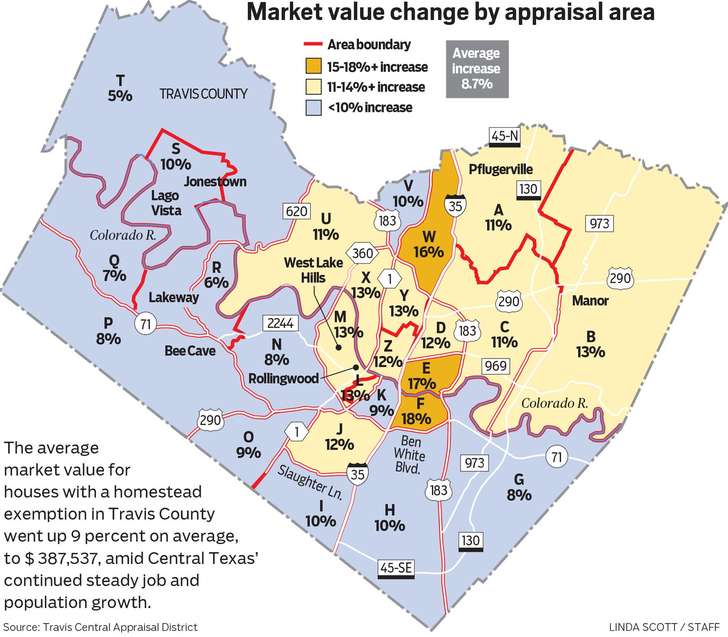
The Travis Central Appraisal District has released the data on 2016 property tax appraisals. As you can see from the map below, some of the most worrisome geographic areas in terms of gentrification are being clobbered again. Look at the dark-colored areas marked W, E and F and note that these Northeast and East Austin neighborhoods are seeing 16%, 17% and 18% appraisal increases. Beyond that, the map is dotted with other assorted double-digit increases.


IMG_0618

Click the map to enlarge it.

Austin Should Consider the Homeowner Retention Initiative

As mentioned in my previous blog posting, I have launched a comprehensive set of ideas for the City and the County to consider. The Homeowner Retention Initiative lays out a range of options to help make home ownership more affordable for both longterm residents and first-time homebuyers. The main focus however, is on our longterm residents who are consistently being priced out of their neighborhoods. The cost squeeze affects both low income and middle class homeowners and renters. So far in my discussions with City Council offices, the response has been very welcoming and encouraging. The issues are very complex and challenging. But I believe strongly that now is the time for a meeting of the minds, within both public and private civic quarters to attack and solve this critical affordability problem.

In the ongoing discussions of the initiative with City Council staff, some interesting perspectives have been raised. I would like to thank Ken Craig in Council Member Ann Kitchen’s office for suggesting that landlords could participate in some of the programs, and thereby be able to offer more affordable rents. When I met with Ashley Richardson in Council Member Renteria’s office, I was impressed with the stack of printed reports that she was prepared to study. And Michael Searle In Council Member Troxclair’s office, along with the other two policy aides, dug into the discussion with lots of detailed questions and insights. Because of some of the complexities, there will be tall mountains to climb. And we may not be able to surmount all of them. But if we can plow through some of the obstacles and achieve a measure of success, then it will have been worth the effort. On Wednesday of this week at 2:00, the initiative will be presented to the City’s Housing and Community Development Committee.

As for the Sting of the Tax Appraisals

We should not blame TCAD for the high appraisal increases. The year-after-year “clobbering” of the taxpayers is caused by the boom in Austin’s economy. Along with planning and zoning decisions. Even more importantly, the Texas Legislature maintains a steadfast insistence on relying more heavily on local property taxes to fund public services than any other large state in the country. I often hear people say, “Oh but this issue of skyrocketing property values is nothing new. California went through all that back in the 70’s and 80’s.” Well, here’s the big difference. Even back in those days, California paid its workers a living wage. And not only that, California voters passed Proposition 13, which froze taxable values at the purchase price of a home. Only after that home went back on the market did it gain a new taxable “market value.” It was an imperfect and controversial solution. But at least California had some kind of solution, along with much better salaries and wages.

We should also note that when the City of Austin, Travis County or any of the other taxing entities set their budgets, they would have to lower their tax rate in order to maintain an even level of spending from the previous year. If they actually did that, then the steep appraisal increases wouldn’t matter as much. But, unfortunately, we gaze at the Austin skyline every year and marvel at the sleek new highrises. Then we see all of the huge multifamily developments along every thoroughfare. And we ask and we wonder…

Where is all the new revenue from all of that new “tax base” going? How much new tax money is being generated each year? And why in the world are they spending it as fast as they can?

If anyone reading this can answer those questions, please drop a comment into this blog post! (And I haven’t given up on asking the City and the County for an itemized list of all of their “plans,” with a grand total of the costs and a public participation process to prioritize all of those plans).

money-flying-away1

Musical accompaniment for this blog posting:

  1. “Taxman,” – the Beatles, Revolver album, 1966
  2. “I Got Stung,” Elvis Presley, 1958

Grocery Stores Go Missing From Austin Neighborhoods – What Gives?

By Bill Oakey – April 10, 2016

As the days, weeks and years tick by in “Progressive Austin,” there is one simple basic need that seems to elude the public officials, paid consultants and public engagement document and pamphlet designers. It’s something called a grocery store. Probably most of you reading this can get to a grocery store without too much time or trouble. Even I can do it, despite not being able to drive. And the walk got easier after City Public Works finally fixed a huge pothole on Possum Trot after five attempts last year. 

But it is no secret that some of Austin’s economically challenged neighborhoods have few grocery stores or none at all. Some of these communities are located in Northeast Austin, Southeast Austin and far South Austin. The Colony Park neighborhood is one example. In nearby Walter E. Long Park, the height of the weeds is surpassed only by the number of years of master planning and official lip service. Those efforts have failed to produce anything beyond a failed November 2000 bond election for a golf course and hotel. Then came the 2014 proposal to put in two privately owned luxury golf courses without a public vote, in apparent violation of the City Charter.

One thing that the Colony Park Neighborhood and probably most other neighborhood associations would agree on is the need for access to grocery stores. We have heard all the arguments about high construction costs and whether the disposable income in some deprived areas could support grocery stores. And after all, it is largely a decision that has to be made by the private owners of such stores. But here’s a suggestion. How about looking into how other cities, counties and various researchers have approached this problem? What potential solutions are out there, and could some of them be successfully applied here?

This Picture Is Worth at Least a Thousand Words, If Not More

Perhaps this picture and the link beneath it will point somebody down at City Hall or at Travis County in the proper direction. It’s a screenshot of one page of Google search results. Feast your eyes on what the search revealed. It should certainly give us some food for thought (pun fully intended). Click here to see the picture.

To do the Google search illustrated above, click here.

For Those In Colony Park Who Want to Spin the Public Engagement Wheel…

There is a brand new set of City-sponsored public process documents here.

Mayhem

Heartwarming movie about a 1960’s housewife and her affordability problems. The grocery store scene is one of the many highlights:

“The Prize Winner of Defiance, Ohio” – Julianne Moore, Woody Harrelson, 2005

Musical accompaniment for this blog posting:

  1. Grocery store love song, “Same Old Lang Syne” – Dan Fogelberg, 1980
  2. Silly grocery store song, “Supermarket Song,” – Jewel, 2011
  3. Even sillier grocery store song, “The Grocery Store Song,” – created in Moorhead State University (Minnesota) dorm room, 2008
  4. Mind-numbing, newfangled headbanger rock, “The Grocery Store Song,” – Boy Kicks Girl (???), 2008 (remastered version)

Watch The Video – March Regional Affordability Meeting

By Bill Oakey – March 31, 2016

The Austin Regional Affordability Committee met Monday March 28th. You can watch the video here. The Committee includes officials from the City of Austin, Travis County, Central Health, AISD and others. Among those are City Council Members Delia Garza, Ann Kitchen and Ellen Troxclair, Commissioner Brigid Shea, and former State Representative and current Central Health Board Member, Sherri Greenberg.

A highlight of this month’s meeting was an affordability presentation by the local nonprofit, Liveable City. This organization sponsored a collaborative gathering of citizens who divided into groups for a day-long affordability forum. The Regional Committee on Monday will also be discussing their ongoing efforts to develop an Affordability Strategic Plan. In the video, you will also see the introduction of my Homeowner Retention Initiative, along with a presentation on the critical issues facing renters from the Austin Tenants’ Council.

We have a tremendous opportunity to join together and work towards real, tangible solutions to Austin affordability. The issues are diverse and complex, but I believe that Austin abounds with the creative and innovative spirit that can truly make a difference. Hopefully, the topical elements and the results of community input obtained at the Liveable City forum will help the Committee build their Strategic Plan.

Click here for more information on the Austin Regional Affordability Committee.

Our Local Leaders Need to Stop Planning And Add Up The Costs

By Bill Oakey – February 22, 2016

One way to at least take a stab at the affordability problem is to look at how many “plans” our local officials have stacked up on various office shelves. And just remember, every time you hear about one more ambitious plan, remember this. Every single one of them comes with a hefty price tag.

Our “new” City Council has now passed their first year in office. We have seen a few notable stumbles on the affordability front. They passed a huge affordable housing initiative, without first realizing that it will cost about $100 million against our water bills and property taxes over the next 20-30 years. And just recently, they accepted the word of a private appraiser, who now estimates that it will cost $360,000 apiece to buy out the latest batch of flooded homes in Southeast Austin. Council Member Ellen Troxclair cautioned her colleagues from the dais that this appraisal figure is highly inflated. She has since confirmed that fact with the Austin Board of Realtors. I have asked the City Council to reconsider these inflated appraisal amounts.

The bottom line is that too many big ticket items are slipping through without the proper amount of due diligence. It was the flood buyout and mitigation program that reminded me of the alarming cost of the growing mountain of city plans. Yes, there is a Flood Mitigation Task Force. And yes, they are working on sort of a plan. It is called “Options for $100 Million Additional Funding.” We can pay for it with up-front cash out of the drainage utility fund or with borrowed money to be repaid from property taxes or the drainage fees.

Close your eyes and try to imagine how many different sets of plans the City has, sprinkled across every office in every department. Suppose the City Council asked the City Manager to make the rounds, gather up all the latest reports on these plans and bring them into a single room. I would like them to do this in the open and invite the public to come down and see how it all turns out.

There is absolutely no telling how many plans there are! That’s the whole point. I am going to formally ask the City this week to lay out all of the published plans and tally up the total cost of every single one of them. Then they need to meet and discuss how to prioritize the plans. Once that step is complete, they should consider reviewing every one of the plans to see which items within each plan are considered essential and which ones can either be postponed or eliminated. From what I can tell, there is no way we could possibly afford the cost of all of the plans, at least not anytime soon.

You might be wondering if I am “planning” to show a list of the plans that I have uncovered. The answer is yes, but I want to warn you first that looking at it might make you a bit dizzy or queasy. So here goes:

1. Bicycle Master Plan (2014) – $151 Million. Here is a teaser from Page 16:

“The cost of priority unfunded investments includes 200 new miles of on-street facilities for $58 million, at an average cost of $290,000 per mile. The cost per mile for on-street facilities varies greatly upon the type of treatment and is accounted for in the estimate. The estimate also includes 47 new miles of Urban Trails at $93 million at an average cost of $2 million per mile.”

2. Sidewalk Master Plan (2009) – $120 million. I am not sure how much of that is left to pay for.

3. Aquatic Master Plan (2016) – $41 million. Aquatic refers to swimming pools. The $41 million estimate is from last year, but the assessment will not be complete until sometime this year.

4. South Central Waterfront Initiative – Master plan due by June 2016

Other examples include:

Urban Forest Plan
Parks and Open Space Plan
Austin Resource Recovery Plan
Urban Trails Master Plan
Community Climate Plan
Watershed Protection Master Plan
Airport Boulevard Corridor Plan
Burnet Road Corridor Plan

It’s Time for a Reality Check!

A complete list would be impossible to assemble by relying on Internet searches alone. The City staff needs to gather these plans up and present them to the City Council for a major overview and affordability assessment. We need a timetable and yearly tax impact determined for every one of these plans before any further planning takes place.

The City needs to realize that voters have turned down bonds for AISD, “Urban Rail” and a costly County Courthouse. We are not living in the 1980’s anymore. We cannot afford the flashiest and the most elaborate park-scapes, street-scapes, and every other kind of urban “scape” that anybody can think of. Many thousands of us are struggling to afford the amenities that the City has right now. It might be nice to have a perfect “zero-waste” resource recovery system. It might be super to have the snazziest, most beautifully landscaped lakeshore in the Western Hemisphere. There is no end to the fantasies that various consultants, committees and task forces could come up with.

But until the current batch of plans is vetted and scrutinized by the City Council and the community, it’s time to call a halt to the creation of any more planning initiatives.

Musical accompaniment for this blog posting:

  1. “50 Ways to Leave Your Lover” – Paul Simon, 1975
  2. “Making Plans” – Porter Wagoner & Dolly Parton, 1980


Taxpayer Shock – City Forgoes Tens of Millions in Federal Home Buyout Funds

By Bill Oakey – January 11, 2016

About a month ago, I suddenly became curious about the money being spent on home buyouts in the Onion Creek area related to the 2013 and 2015 floods. It occurred to me that none of the news reports addressed the question of where all of the money was to come from. How much of it, I wondered, was coming from local dollars, and how much of it was being matched by Federal grants? The local funding for these flood-related projects comes from the monthly drainage fees that we pay on our utility bills.

After doing some research on the topic and submitting questions to City officials, I received a detailed and disturbing response. The City’s Watershed Protection Department replied to my questions with a partially complete summary of the flood mitigation spending that actually goes back to 1999. So, here’s the bottom line. For the projects included in the response, the total cost is $170.17 million. Out of that total, only $55.77 million will ultimately come from Federal matching funds.

The chart below, provided by the Watershed Protection Dept. shows the breakdown of the Federal and local spending on these projects:

Lower Onion Creek Flood Mitigation Project

Lower Onion Creek Buyout   Total Project Local Funding  Federal Funding  Pending Federal
Project                                       Cost                Share                Share                    Reimbursements

Corps Project Area*                $73.2M          $18.9M             $54.3M                  $22.9M
25-Year Project Area               $35.5M          $35.5M                     0                             0
100-Year Project Area           $61.47M          $60.0M             $1.47M                  $1.47M
Totals                                     $170.17M        $114.4M           $55.77M                $24.37M

*Note: Values are for the overall Corps project since 1999 for all phases: buyouts, ecosystem restoration and recreation.

In an email from Stephanie Lott, Public Information Specialist from Watershed Protection, she states that the above chart does not include all of the flood mitigation projects since 2013. Most disturbing for local taxpayers is the additional comment, “From asking some of our managers, it doesn’t sound like there are any other flood mitigation projects since 2013 that included federal funding.”

The response leaves a number of critical unanswered questions:

  1. Why did Austin receive such a tiny share of Federal reimbursements for these projects?
  2. Did the City take advantage of every possible opportunity to apply for Federal funding?
  3. Should the City be eligible for any State matching funds for the home buyouts?
  4. Did the City work with the State to submit a flood mitigation plan to FEMA that included all of the anticipated Onion Creek home buyouts? (See “The Federal Grant Application Process” below).
  5. Why does the City assume that none of the remaining home flood buyouts since 2013 will  receive any Federal funding?
  6. Has the City Council been fully informed about the limited, and in many cases nonexistent Federal funding for the large number of previous and pending home buyouts?
  7. What plans, if any, does the City have for applying for Federal funds for future buyouts of flooded homes?

 The Federal Grant Application Process

It was not difficult to track down the Federal guidelines for assistance in home buyouts in flood prone areas. See this link entitled, For Communities Plagued by Repeated Flooding, Property Acquisition May Be the Answer.” Below are some excerpts from the document:

For eligible communities, FEMA typically funds 75 percent of the cost of property acquisition with the municipality and state contributing the remaining twenty-five percent. FEMA does not buy houses directly from homeowners. Buyout projects are initiated and administered by local and state governments with grant funding support from FEMA. “Additional federal funding may also be provided by the Community Development Block Grant program administered by HUD.”

“To qualify for federal funding for the acquisition of flood-prone properties, a state must create a flood mitigation plan, which is then submitted to FEMA for review and approval. In its mitigation plan, the state identifies communities that have experienced losses due to repetitive flooding and, once the plan is approved by FEMA, notifies those communities that funding for property acquisition may be available.”

Also, see how the Harris County Flood Control District handles the grant application process. Note the sections entitled, “Federal Funds for Voluntary Buyout,” and “Federal Eligibility Requirements.”

Mayor Adler and the City Council should review these guidelines and pose some hard questions to the Watershed Protection Dept. If FEMA and HUD funding is available to cover “typically 75%” of flooded property acquisitions, then why has the City been relying on local drainage fee funds to cover the entire cost? If, in fact, the City Manager and his staff have dropped the ball to the tune of tens of millions of dollars, then who will be held accountable? And how soon can the City set about correcting these deficiencies to the future benefit of Austin utility ratepayers?

Stay tuned for an update on this issue as soon as any response from the City becomes available.

Leslie Pool Takes The Lead In Battling Fee Waivers

By Bill Oakey – November 23, 2015

City Council Member Leslie Pool sponsored a resolution last week that will help protect taxpayers from the burden of subsidizing special event fee waivers next year. Ms. Pool took the time to call me in response to my previous blog posting regarding public safety spending for 2016 special events. The key point as she explained it is that she has tracked down another funding source that will not come from taxpayers. There is a Business Retention and Enhancement Fund that is being considered for this purpose. This fund contains the $2.4 million returned to the City from White Lodging, as a result of their lack of adherence to their incentive agreement.

I will take this opportunity to apologize to Council Member Pool for not contacting her before I published the blog posting on the resolution that she sponsored. She has made it clear that she supports a long-term solution that will reduce or eliminate taxpayer subsidies for fee waivers. This has been a long and treacherous affordability battle, and it’s great to know that Leslie Pool is in our corner and taking the lead on this issue. The resolution that she sponsored and got passed is an important first step in the right direction. Now it is up to the City Manager to follow through with a plan for alternate funding sources for special events and the permanent elimination of fee waivers – finally!

The Fee Waiver Controversy Gets A Brand New Twist – And It’s A Humdinger!

By Bill Oakey – November 11, 2015

We all remember the big brouhaha over special event fee waivers that has raged in the press and at City Council meetings over the past couple of years. It’s a twisted tale of a City Council resolution seeking “alternate funding sources” for the multimillion fee waivers for SXSW and other large event promoters. Of course the money to pay for these waivers comes from you and me, the taxpayers.

So, here’s a quick recap. In May of 2014, Mayor Pro Tem Kathie Tovo got a resolution passed unanimously to direct the City Manager to develop a plan to remove the local taxpayers from the fee waivers and pay for them with alternate funding sources. Her suggestions included surcharges on ticket sales and possibly a portion of the Hotel Occupancy Tax. The first resolution deadline of August 2014 came and went with no action. Then a November 2014 memo surfaced, promising a new deadline of August 2015. When that deadline slipped away, I asked for help from a City management contact person.

Mr. William “Bill” Manno in an office called “Management Services” sent me an email this past July 10th, stating that a draft report responding to the Council resolution would be delivered to the City Council by “October, if not sooner.” On Tuesday of this week I emailed Mr. Manno and asked him to please send me a copy of the report.

City politics is a lot like participating in a real life novel of mystery and intrigue. The level of gamesmanship that goes on behind the scenes is stunning. One of my best inside sources at City Hall alerted me today of a fascinating twist in this saga. First, let me mention one quick thing. The City Council accepted my appeals not to include any funding for special event fee waivers in this year’s budget. All along I’ve been hoping that my compromise proposal for alternate funding sources might have a chance.

Well, take a look at these two items coming up on the Council’s Nov. 19th agenda:

67. Approve an ordinance amending the 2015-2016 Fiscal Year Budget to provide funding for public safety during South by Southwest.

( Notes:   SPONSOR – Council Member Leslie Pool )

68. Approve a resolution directing the City Manager to create a long-term plan to address overall public safety during the spring festival season.

( Notes:   SPONSOR – Council Member Leslie Pool )

You will notice one piece of terminology that is conspicuously missing from these items. You guessed it, the phrase “fee waiver” do not appear in the agenda verbiage! Someone with Karl Rove’s knack for political maneuvering decided that “public safety funding” sounds a whole lot prettier and nicer than the dirty old ugly term “fee waiver.” But the end result to the taxpayers is still the same. Instead of requiring event promoters to pay their own fees for City services, or using ticket surcharges or Hotel Occupancy Tax funds, the problem can be solved by simply passing a budget amendment. Let the taxpayers subsidize the additional public safety services.

Since Leslie Pool was not on the Council during the loud public controversy over fee waivers, perhaps she was seen as an easy target by the special interests who have worked behind the scenes to protect the status quo on fee waivers. But the cat is now out of the bag and we still have time to push for adoption of the alternate funding sources originally conceived in the 2014 Tovo resolution.

Here Is My Proposal for Special Event Funding

Compromise Funding Proposal for Special Events By Large For-Profit Companies

By Bill Oakey – November 11, 2015

  1. Do not approve any designated “public safety funding” for special events until a policy is adopted pursuant to Mayor Pro Tem Tovo’s Resolution # 20140501-036. This was the resolution calling for the City Manager to develop an alternate funding plan for special event fee waivers. Please note that Mr. William “Bill Manno” in the Management Services Office made a commitment this past July 10th that a report would be delivered to the City Council by “October of this year, if not sooner.” Providing public safety funding for special events equates to the same thing as granting fee waivers, regardless of whether the “fee waiver” label is used.
  1. Do not approve any multi-year agreements with special event organizers until a non-taxpayer supported funding policy has been formulated.
  1. Ask City staff and the appropriate task force / committee members to develop and recommend a compromise funding strategy with the following three elements:a. A portion to come from the Hotel Occupancy Tax funds. (This would require amending City Code Chapter 11-2, Section (B) (3) that allocates 15% of Hotel Occupancy Tax receipts to the cultural arts).b. Surcharges added to ticket prices for those events. A study could be done to estimate the amount that could be generated from the surcharges at various levels, such as 25 cents, 50 cents, one dollar, etc.

    c. Require the special event companies to pay a portion of their own fees. As a part of this component, the outside companies that piggy-back on SXSW should be required to pay a reasonable fee (or an increase in their current fees, if there are any) when they apply for their permits. SXSW itself may not be entirely to blame for the entire funding gap that has been attributed to them.

Please note that the City’s total service costs for special events exceeds the cost of the current fee waivers. The funding gap was $4.2 million in 2013, per the City Transportation Dept. Report. That’s because the City does not set the fees high enough to cover the actual cost of all services provided. Therefore, the new funding policy that replaces the fee waivers should be formulated sufficiently to completely eliminate any funding gaps. That would result in a zero-cost impact on the local taxpayers. That is what we need. The bottom line is that local taxpayers can no longer afford the cost of the fee waivers. The current fee waiver system is one of the most unpopular programs in all of City government.

It’s Time For Taxpayers To Contact The City Council – Watch Out For The Budget!

By Bill Oakey – August 20, 2015

Many thanks to Council Aide, Michael Searle in Council Member Ellen Troxclair’s office. He provided me with a document that shows the current status of proposed cuts and additions to City Manager’s proposed City Budget. Today it is available online. You can read the details by clicking the link below:

City Budget Concept Menu Aug 20

There Is Good News and Bad News

One piece of good news not noted in the chart is that, according to an information request from  Council Member Troxclair, there are no funds budgeted for special event fee waivers. If this position holds, it will be a major victory. It is long past time for the City to pay for special event services from sources other than local taxpayers.

The bad news is the bottom line. This current “budget concept menu” calls for $30.7 million in increases to the General Fund budget, with only $13.4 million in spending reductions. It should be noted, however, that several of the budget change suggestions from Council members have not been quantified yet by City staff. Those items are labeled, “TBD” – To Be Determined. So, in all fairness, the jury is still out on whether this current menu would offer pain relief to taxpayers or serious indigestion.

A Closer Look At Some Of the Highlights

  1. Item 2.13 – Council Member Troxclair recommends freeing up $9.7 million in Budget Stabilization Reserve funds. This would lead to taxpayer savings.
  2. Item 2.14 – Huge Kudos for Troxclair! This item would end three layers of utility subsidies for “economic development” (giveaways for corporate recruitment) to the tune of $11 million. This would lower our utility bills.
  3. Item 2.4 – Thanks to  Mayor Steve Adler. Debt financing of select capital expenses would free up $12.9 million in reserve funds that could lead to tax savings.
  4. Item 2.3 – Thanks to Council Member Don Zimmerman. Implement a sliding scale for City employee pay raises. This would save a total of $7 million. Why should the fat-cats at the top of the scale get continuous big raises every year, while tens of thousands of Austinites struggle with stagnant wages?
  5. Item 2.2 – Thanks to Mayor Steve Adler. He offers an alternative plan for the tiered pay increases that would save $4.7 million.
  6. Item 2.23 – More thanks to Ellen Troxclair. This item calls for a staff pay increase structure that would save $6 million. We need to press the City Council to adopt either the Adler, Zimmerman or Troxclair plan!
  7. Item 3.3 – Thank you, Mayor Pro-Tem Kathie Tovo. Increase Development Services fee to 100% of cost of service. This would save us $1.4 million.
  8. Item 3.6 – Huge thanks to Council Member Sheri Gallo!. Increase Senior Homestead Flat Exemption to levels comparable to 2005 property valuations.
  9. Item 3.13 – Troxclair again! Freeze utility rates and fees to this year’s levels.
  10. Item 2.18 – Still more kudos to Troxclair. Limit additional police positions to 53. The staff’s ambitious increase in police is too much for one big jump in this year’s budget.

Here Is What You Can Do to Help!

This is our big chance to really make a difference in affordability. We need to let every City Council member know that we want meaningful reductions to the budget without being totally swallowed up by budget increases. In other words, tangible relief in taxes, utility rates and fees.

So, please take the time to email the Mayor and all Council members, using this one-click email link. Then, please send emails, texts, Facebook and Twitter postings to as many neighbors and friends as you have on your lists. If we all join together, we can score a nice victory in the new budget. Time is very short, so let’s get the action started now!