Tag Archives: Austin Taxes

City Should Aim For Midyear Budget Amendments

By Bill Oakey – November 18, 2025

Some Budget Cuts Can Be Restored Midyear

There is a mad scramble at City Hall to slash the current fiscal year budget, in the light of Prop Q’s failure. Employee unions for police, fire and EMS are pushing hard to keep staffing levels and pay increases that were in the Prop Q budget. Other civic groups are clamoring for funding of services that they say are vital to the community.

The missing element in these frantic discussions is the strong message that voters sent to City Hall when they overwhelmingly rejected Prop Q – We want more transparency, efficiency and accountability in City spending. In my nearly 40 years of following City Budget battles, I have rarely ever seen a City Hall led discussion about how to make meaningful reforms to hold down costs to taxpayers. You can mark this month on your calendars – The Day of Reckoning has finally arrived!

The City Manager’s Plan Could Lead to Midyear Budget Adjustments

City Manager, TC Broadnax issued a memo the day after the Prop Q election. It outlines several steps he plans to take in an efficiency review. You can read about it here in a KXAN News story.  Here is the City Manager’s memo, “Efficiency and Optimization of City Services in Fiscal Year 2026.” The strategies include:

Independent assessment of operational efficiency and service delivery.

Benchmarking against comparable organizations to identify best practices.

Data-driven analysis of resource allocation and organizational design.

Recommendations for cost savings, service improvements, and structural adjustments.

In addition to these initiatives, City Council member, Marc Duchen and his staff are leading the effort to seek out as many cost-saving options as possible.

Perhaps a Midyear Budget Revision Could Take Effect on April 1st

The efficiency reviews, and there could indeed be more than one, will most likely play out over many months, if not years. But I am not April-fooling when I suggest that the City should set a goal of identifying cost-savings that could restore some essential City services halfway through this fiscal year.

And What About Those Huge Homeless Services Contracts?

As the raucous voices put forth their choices at City Hall this week, regarding spending cuts, I have not heard any words ECHO-ing off the wall (pun fully intended) about renegotiating homeless services contracts. Austin has by far the highest local cost share of homeless spending in the entire state. It’s the Day of Reckoning, so reforms are beckoning!

The ultimate goal should be to apply significant cost savings towards taxpayer relief in future budget years. The national affordability crisis will likely persist for quite some time. I recommend establishing a Taxpayer Reserve Fund, to be used for lowering taxes in subsequent years.

Fingers crossed that the folks at City Hall will heed the voters’ message. Their duty is not to just argue about cutting vital services. It’s the structural and cultural attitudes about spending that need to be addressed. Otherwise, few among us will be impressed.

Musical Accompaniment for This Blog Piece:

1. “Halfway to Paradise” – Tony Orlando

2. “Half the Way” – Crystal Gayle

How You Can Vastly Increase Voter Turnout To Defeat Prop Q

By Bill Oakey – November 3, 2025

Tomorrow is Election Day. With a few simple steps, you and I and our friends can drive the final nail into Prop Q’s coffin.

We Just Need to Get People Out to Vote!

We can do that by sending a series of messages, designed to go viral throughout today. Take the sample message show below. Modify the wording if you wish. But keep it short and simple. Next,  copy the message. Then you can easily paste it into a dozen or two emails, addressed to people in your Contacts. And also, please post it to your social media.

Here is a sample message that you could use:

Please be sure to vote tomorrow. Make yourself a note, or put it on your calendar. Vote “No” on City of Austin Proposition Q. Ignore the misleading ballot language. This is an unaffordable 20% property tax increase that will hurt homeowners, renters and small businesses. It will create a fresh $100 million slush fund every year, forever. See more information at AustinAffordability.com. (Be sure to include the sentence below).

Please take the time to post this message to your social media, and email it to as many of your friends as time allows.———————————
Hopefully, this strategy will cause the messages to multiply like a chain.

Musical Accompaniment for This Blog Posting:

“Drivin’ Nails In My Coffin” – Asleep at the Wheel, from their first album in 1973.

Early Voting Is Here – Rally Your Neighbors To Oppose Prop Q!

By Bill Oakey – October 20, 2025

We Need to Spread the Message

The facts are on our side, but not everyone has heard the message. Each one of us should take some time to alert friends and neighbors. Post links to this blog or similar outreach materials to your social media. Send out emails.Talk to the folks on your block.

Myths Vs. the Facts – Spread the Word

1. Shameful Myth – Public safety, parks and libraries and apple pie will wither away without Prop Q.

Fact – All of the basic services and wishlist items can still be funded in the City Budget if Prop Q fails. As the Chamber of Commerce pointed out, the City Manager produced a balanced budget.

Fact – City officials can adopt the same belt-tightening that your family and others are using in this harsh economy. They can learn from Houston, Dallas and San Antonio.

2. Crazy Myth – Only Republicans and conservatives are against Prop Q.

Fact – The Travis County precinct chairs were evenly split over endorsing Prop Q. The party chairman rolled over and broke the tie. That endorsement is laughably weak.

Fact – The groundswell of taxpayer resistance to Prop Q crosses all party lines. The crazy, partisan tactics in the For Prop Q mailers are a joke. Toss those into the recycle bin!

3. Silly Myth – “This is not about taxes, it’s about our values.”

Fact – Austinites don’t value the prospect of huge rent increases. We don’t value watching our beloved, iconic local businesses closing, because they can’t afford the taxes. And we certainly don’t value anyone losing their home.

Fact – Austin’s spending on the homeless is massively higher than any other major Texas city. The compassionate thing to do is bring the spending under control, and use performance measures for effective results. Just throwing money at the problem hasn’t worked – not even close!

Never Forget That This Is a “Forever Tax”

Over $100 million every single year, into eternity. Remember this image when you go to sleep tonight. Then show it to your friends when you wake up. And don’t forget to vote!

A New Prop Q Poem

Early voting is here, you can now have your say
Don’t let anything stand in your way
The most important thing you can do
Is rally your friends to vote NO on Prop Q!

Beware of false messaging and misleading factors
Prop Q’s big donors are all City contractors
The Budget can be balanced, I’m not pretending
The City just needs to cut wasteful spending

The wishlist of programs that Prop Q is touting
Can still be funded, no need for the shouting
A NO vote would just bring fiscal responsibility
And push City Hall toward affordability

Musical Accompaniment for This Blog Piece

”The Long and Winding Road” – The Beatles

Chamber Of Commerce Opposes Prop Q

By Bill Oakey – October 8, 2025

I am quite happy to share this news! Here is their statement, from this weblink.

Austin Chamber Board of Directors Opposes Proposition Q
City of Austin Tax Rate Election

On November 4th, voters in Austin will head to the polls to consider a tax rate election that would increase property tax rates in the City of Austin by over 16%. Austin has experienced strong economic growth in recent years, but with this success has come significant challenges, chief among them is affordability. Over the past ten years, the typical Austin homeowner’s tax bill has increased by over 65%. This trajectory is unsustainable and at a time of great economic uncertainty, it is imperative that our local governments exercise fiscal restraint. The City Manager’s original budget stayed within the maximum allowed increase without requiring a tax rate election. That budget also fully funded core services including public safety.

Last month, the Austin Chamber wrote to Mayor Watson and Council Members urging Council to minimize property tax increases on residents and businesses. We recognize the challenging circumstances surrounding this year’s budget but were disappointed with the Council’s near unanimous decision to increase property taxes by over 16%. This increase is on top of higher than normal increases in several other taxing jurisdictions including Travis County and Central Health. Austin must remain an attractive destination for economic development and job growth, and this dramatic increase in taxes will likely push people out of Austin and negatively impact our ability to attract new investments in our city. Businesses in Austin experience an outsized share of rising fiscal pressures, and the Austin Chamber remains concerned that further property tax increases will lead to more businesses moving out of our city.

It is for these reasons that the Austin Chamber Board of Directors opposes the City of Austin’s Tax Rate Election on this November’s ballot. If we fail to prioritize affordability today, we risk losing the very people and businesses that have made Austin a thriving community.

Sincerely,
Mark Ramseur
Board Chair
Austin Chamber of Commerce

Stop The “Forever Tax” – Vote No On Prop Q!

By Bill Oakey – September 29, 2025

$100 Million Dollars – Three Times The Amount Of The Budget Shortfall, Every Year, Forever!

The City Tax Rate Election on November 4th is something to tell your friends, neighbors and colleagues about. The City claims to have a $33 million budget shortfall. But, if the voters approve Prop Q, the folks at City Hall will end up with a huge slush fund. This thing would generate over $100 million. The property tax rate accumulates each year, and becomes the new baseline for the following year. So, the $100 million tax windfall would repeat itself until the end of eternity!. It’s a Forever Tax. And, the City can pass annual regular tax increases on top of the Forever Tax. We simply can’t let this happen!


Why Is The City Asking For All That Money?

Please, please, please don’t be fooled by the ballot language on Prop Q. It is worded to make you fear that our parks will crumble into decay, and even fewer police officers will patrol our streets, without the Forever Tax. The language is very broad, generic and vague. You will not see any specific departmental programs or services that will be expanded if Prop Q passes. And City officials have not told us exactly which specific programs or services will be impacted if Prop Q fails.

A Huge Bombshell That No One Is Talking About!

We deserve to see a detailed accounting, showing the items within each department that would be funded, expanded or reduced, depending on the outcome of the election. Well, last Friday night, instead of watching “Superman” on HBO Max, I explored the FY 2026 Approved City Budget. On Page 917, I discovered a set of General Fund Financial Policies for Tax Rate Elections. Here is Policy #3:

“The City shall clearly identify the level of programming or services funded with the additional revenue generated above the voter approved rate, and provide an accounting of the expected level of services should the election fail.”

There is a City Council Resolution that formalized this policy. It began as a recommendation that passed unanimously by the Audit and Finance Committee. Then, on May 22 the City Council unanimously passed it as Resolution No. 20250522-058.

Where Is The Transparency That Was Promised Back In May?

That question will be put to the City Council while you are reading this. In the meantime, here’s a little history lesson about the City Budget. Several years ago, I got a surprise phone call from 1980’s era City Council Member, Max Nofziger. He shared what he had recently learned about the budget. From its earliest days until the year 2000, it went up on a gently inclining slope. From 2000 onward, it has shot up into the sky.

The City Should Manage Its Budget The Way Austin Families Do

If Prop Q fails, the City will still have the maximum tax increase allowed by State law. In this tough economy, many Austin families are struggling. People have to do without what they want, or postpone things until they can afford them. With Prop Q, homeowners and small businesses would suffer. Landlords would pass their costs on to renters. This is the wrong time for a walloping tax increase.

Ax The Tax! Vote No On Prop Q!

For additional info, check out AustinTaxRateElection

Musical Accompaniment For This Blog Piece

1. “One Minute Past Eternity” – Jerry Lee Lewis

2. “Forever” – The Little Dippers (Actually the Anita Kerr Singers)

3. “Everybody’s Somebody’s Fool” – Connie Francis

4. “Eternally” – Petula Clark

5. “Please Love Me Forever” – Bobby Vinton

6. “Taxman” – The Beatles

AISD Bonds Will Cost Over 7 Times What Voters Have Been Told!

By Bill Oakey – October 24, 2022

The big $2.44 billion AISD bond proposition on the ballot will cost taxpayers many times more than the one penny per $100 valuation that they have publicized. They skirted around the law with a crazy loophole. State law requires them to publicize the tax impact on a $100,000 home. So, technically, that is what they did. The estimated tax rate impact would be one cent, if you take the $100,000 home value and subtract the $40,000 homestead exemption. That leaves just $60,000 as the valuation to apply the tax rate to.

Well, that’s misleading, because the median home taxable valuation in Austin is over $500,000. And the $40,000 homestead exemption applies to the whole taxable value. So, $500,000 minus $40,000 leaves $460,000 to apply the tax rate increase to! $460,000 is over 7 times higher than $60,000. So, the tax impact on the owner of an average home is at least 7 times higher than what the voters have been told!

Voters just need to keep this in mind. The greater Austin area has never had a $2.44 billion bond issue in its entire history. We have had many smaller bond issues that have raised taxes more than one penny per $100 evaluation. So, how is it possible that this one could be so different? How could the taxpayer impact be so small?

The Answer Is Simple – It Can’t!

This information was provided to me over the weekend, by former Travis County Tax Assessor-Collector, Bill Aleshire. AISD officials have some explaining to do. They need to be called onto the public carpet and held accountable. The full cost to the taxpayers is required under the spirit of the law. Taxpayer advocates have already met with lawmakers, including Senator Paul Bettencourt, to ensure that the gaping loophole is tightly sewn up, during the next Legislative session in January. 

Using such a loophole to deceive voters is shameful, and reflects poorly on AISD’s Board of Trustees – or should I say, Board of Mistrustees? Check it out. Go to the AISD website. Under the heading, “2022 Bond,” Click on “Voter Information Documents.” 

On the first page, in Item number 7, AISD states that the estimated tax increase on a $100,000 home is only $6.00. But they subtracted the $40,000 homestead exemption. That means that they are only using $60,000 to do the tax increase calculation.

For an accurate and honest message to the voters, AISD should have show us what the estimated new tax would be on a median-value home, at over $500,000. The tax amount will probably be higher in the first couple of years, because of the steep rise in interest rates. And AISD did not publish what the tax impact would be in later years, as more bonds are gradually sold.

Austin Community College (ACC) has a $770 million bond on the ballot. Their taxpayer impact is estimated at $5.00 on a $500,000 home for the first five years, and $25 per year for each year thereafter. You can easily see that AISD’s estimate for $2.44 billion in bonds is wildly understated. Here is the link for ACC.

The Total Amount of Bonds On the Ballot Adds Up to $3.56 Billion!

AISD’s $2,440,000,000 + ACC’s $770,000,000 + Aistin’s $350,000,000 = $3.56 Billion

Any way you slice it, this is an extraordinary, historic event for the Austin area. And yet, it has flashed before our eyes with barely anyone noticing. And early voting started Monday. Any of you who are over 65 or disabled won’t be hit as hard. But everyone else should buckle up, and prepare for some severe property tax shock, along with a triple dose of electric rate shock, which starts at one minute past midnight on Halloween night…

The saddest part of all this is that AISD really needs the school upgrades and repairs that the bonds would fund. Voters will need to make some difficult choices. AISD should help them by immediately clarifying the misleading information, with clear, simple, full and complete facts. And do that as soon as possible.

What Happens In School When Somebody Misbehaves?

Several AISD officials should be summoned to the nearest principal’s office. A designated teacher should smack each one of them with a ruler…See photos below:


Your Over-65 School Tax Freeze Will Thaw – And That’s Good News!

By Bill Oakey – May 24, 2022

My mother always told me not to refreeze anything in the refrigerator, after it has been frozen once. But that does not apply to our currently frozen over-65 and disabled school property taxes.

We have one adventurous news hound in Austin to thank for chasing down this winding tale of a story. I tip my hat to Bridget Grumet at the Austin American-Statesman. This will make you want to follow her reporting every week.

Grumet: New school property tax ceiling is ‘a 15-step math problem’ that benefits seniors

Bridget Grumet
Austin American-Statesman

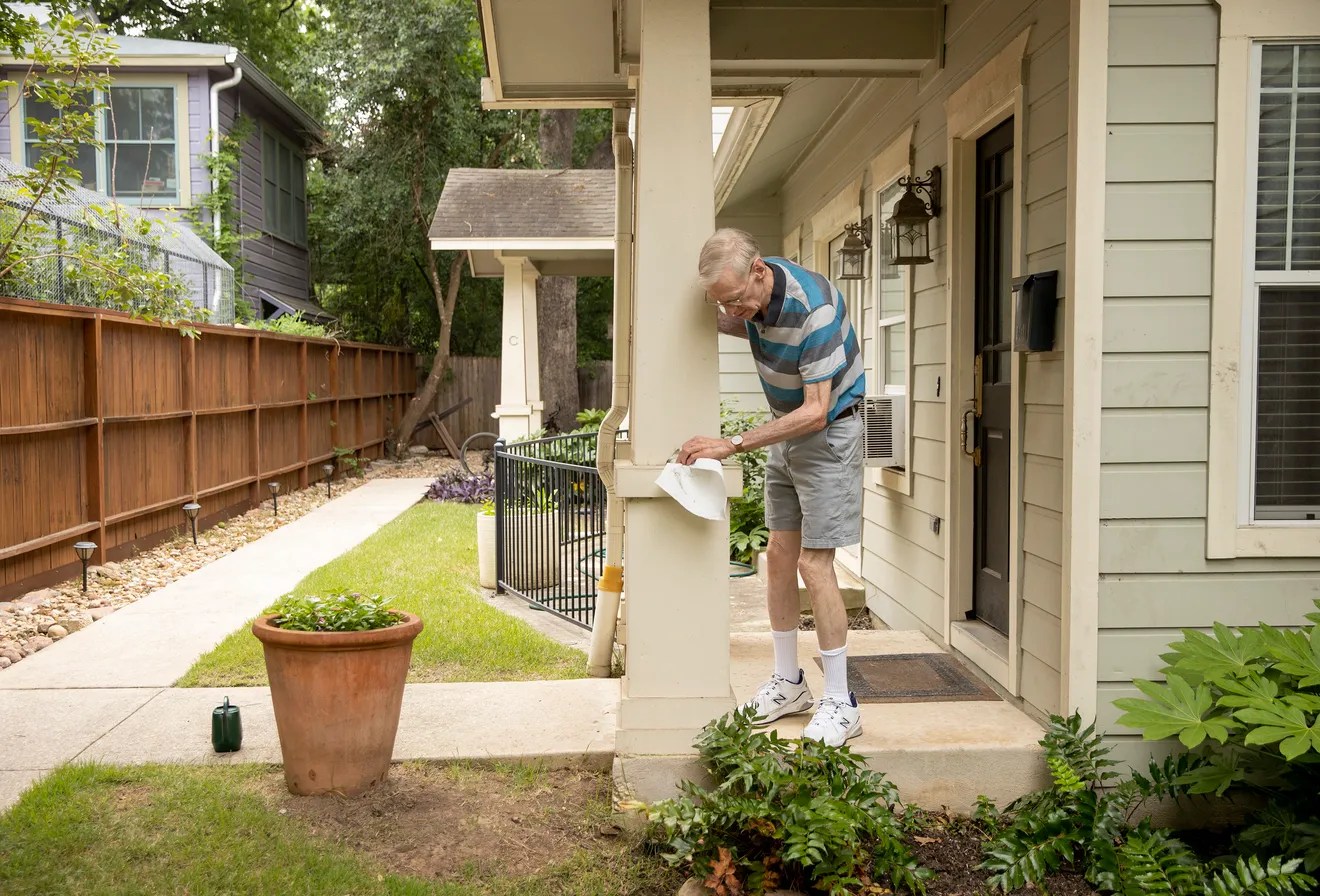
Bill Oakey cleaning his West Austin condo. Photo by Jay Banner, Austin American-Statesman

The vast majority of voters in the May 7 election — nearly 87% — decided to lower the tax bills for homeowners who are disabled or over 65. But do you understand exactly how we just changed the school property tax freeze that has been a financial lifeline for about 2 million Texas households?

Don’t feel bad. I didn’t know the mechanics of it, either. Nor did Bill Oakey, a retired accountant and longtime taxpayer activist who runs the blog at AustinAffordability.com.

“Will our school taxes be reset back to the dollar amount that we paid in 2019? And then refrozen at that amount?” Oakey asked me a few days after voters approved Proposition 1. “Or will they be refrozen at whatever dollar amount they’re at in 2023?”

Actually, none of the above.

I promise you, this is a good news story for taxpayers. And I’ll do my best to keep the math digestible. But I figured if someone as plugged in as Oakey didn’t understand how Prop 1 worked, we could all use a fuller explanation.

Tax freeze was ‘a miracle’

For decades, as soon as a Texan got the special homestead exemption for older or disabled homeowners, that person’s school property taxes were frozen at that year’s amount. The school portion of their bill couldn’t go above that ceiling in future years, although it could be lower. (Notably, the freeze doesn’t apply to city or county taxes.)

The school portion of my property tax bill has shot up more than $700 over the past five years, so I can imagine what it means for older adults on fixed incomes to know they’re shielded from those kinds of costly spikes over the long term.

“Everybody I know that lives in Austin now, including me, probably wouldn’t be able to stay here if not for the over-65 tax freeze,” Oakey, 74, told me. “It was just a miracle it was on the books.”

But the freeze became an impediment of sorts in 2019, when the Legislature passed House Bill 3. The massive school finance reform package included a complicated plan to “compress” the school property tax rates, reining in the surging bills for homeowners like me.

That didn’t do much for older or disabled homeowners, though, because their bills were already frozen.

How low can it go?

Prop 1, the measure Texas voters approved this month, aims to bring some relief to that group of homeowners. But I must warn you, this is not the kind of thing you can calculate yourself.

“It’s like a 15-step math problem,” said David Clark, a senior policy analyst for state Sen. Paul Bettencourt, the Houston Republican who authored the legislation behind Prop 1.

Here’s the basic gist:

Next year, tax collectors’ offices will unfreeze the school property tax bills for seniors and disabled homeowners, then recalculate by factoring in the compression rates for 2019, 2020, 2021, 2022 and 2023. That will be the catch-up year for those homeowners, getting the benefit of several years’ worth of reduced rates that the rest of us already got.

As a result, the 2023 tax bill for older and disabled homeowners will be lower than their previous “frozen” amount. Then, under Prop 1, that lower amount becomes the new ceiling.

But not forever.

In 2024, and each year after that, the bill is once again unfrozen and recalculated, using the latest year’s compression rate, which is provided by the Texas Education Agency. In a worst-case scenario, if we hit a recession, the school property tax bill would stay the same as the year before. But most of the time, Clark said, the bill should drop a little more each year.

And each year, the lower amount becomes the new ceiling.

It’s like older and disabled homeowners are trading their tax ceiling for a limbo stick.

I should also note: As property owners pay less, the state is kicking in more dollars to ensure school districts don’t lose funding. The state dollars come from the general revenue pot that includes sales tax, taxes on the production of oil and natural gas, and other tax streams.

That infusion of state dollars is long overdue. For years, the state had reduced its contribution to school budgets because soaring property values led to higher property tax collections from the local districts. But, as any homeowner who has paid those bills knows, the rising burden on local taxpayers was unsustainable.

Making sense of your bill

You might have heard that under Prop 1, older adults on average will save $110 in 2023. Where did that figure come from?

Clark told me that Prop 1 will bring an estimated $220 million drop in school property tax collections from older and disabled homeowners that first year. Divide that by the 2 million Texans who get those particular homestead exemptions, and you arrive at $110.

Using similar back-of-the-envelope math, the state projects an additional $125 savings for those homeowners in 2024.

In reality, each senior or disabled homeowner has specific factors — how long they’ve had the tax freeze, what’s happening to home values in their area, what the compression rate for their district is — that make it impossible to guesstimate what Prop 1 will mean for their specific tax bill.

Photo by Jay Janner – Austin American-Statesman

Even local tax officials are still wrapping their heads around Prop 1. They’ll also have to factor in the other measure voters approved May 7, an increase to the general homestead exemption for all Texans.

Instead of knocking $25,000 off the value of a home when calculating school property taxes, Proposition 2 knocks off $40,000. (Older and disabled residents already get an extra $10,000 exemption on top of the general one for all homeowners.) Depending on how low their already-frozen bill is, however, older and disabled homeowners might not notice much of a difference from the higher homestead exemption under Prop 2.

Officials in Travis County, where nearly 75,000 people have the older adult or disabled person’s homestead exemption, expect to compare notes with other tax collectors and work with their software vendors to figure out the best way to calculate the bills.

Then it will be a matter of helping homeowners understand their 2023 bills, though I’m guessing most taxpayers will be satisfied with the bottom line.

“Usually people are pretty happy when their tax ceiling goes down, as long as they know it’s not an error,” Tiffany Seward, spokeswoman for the Travis County Tax Assessor-Collector’s Office, told me.

And that was pretty much the case when I relayed all of this to Oakey. The math was more complicated than either of us expected. But given the rising cost of living, and the fact that retired teachers and retired state employees haven’t seen a cost-of-living adjustment in roughly two decades, Oakey welcomed the tax break.

“I’m very happy to hear they’ve done this,” he said, “because seniors are losing ground.”

Grumet is the Statesman’s Metro columnist. Her column, ATX in Context, contains her opinions. Share yours via email at bgrumet@statesman.com or via Twitter at @bgrumet. Find her previous work at statesman.com/news/columns.

Musical Accompaniment for This Blog Posting:

1. “The Freeze” – Tony and Joe, 1958
2. “Let It Go” – From Disney’s “Frozen”
3. “Limbo Rock” – Chubby Checker, Original 1962 single version
4. “Taxman” – The Beatles

Yikes! The New Property Tax Appraisals Are Out!

By Bill Oakey – April 15, 2022

The City of Austin’s relentless march to obliterate all long term residents and replace us with the ultra-rich took another giant leap this morning. The Travis Central Appraisal District (TCAD) has posted the new property tax appraisals on their website. If you just placed an order for a new Tesla, and you registered for the VIP presale tickets for the Zilker Botanical Gardens Ion Art Night at $400 per couple, plus fees, plus taxes, then you can skip this blog piece. But if you have lived in Austin most of your life, and you are responsible for helping to create our high quality of life, then keep reading. You still matter to tens of thousands of your neighbors and friends. You still have a right to belong in the city that you helped build, and you supported with your taxes.

To look up your new tax appraisal, go to this link, and enter you name or your property address. Scroll down to the bottom, and click on “Values.” The line labeled “Market” is your total appraisal. The “Net Appraisal” is the adjusted amount, after any homestead exemptions and the 10% annual appraisal cap. Keep in mind that if your total appraisal is reduced by the annual cap, then that higher amount will stay in your account, and you’ll get 10% increases every year until you reach the total.

Check out the helpful, but frightening news story from KXAN below. Investors around the world are salivating over the easy money they can make by gouging Austin renters, and toppling all of our neighborhoods. But we have a tough spirit, and we vote in large numbers. Enjoy this nice spring day, while you still can!

Travis Co. Appraisal District says its market values have been ‘too low.’ What does that mean for your notice?

Updated:

TRAVIS COUNTY, Texas (KXAN) — The Travis Central Appraisal District (TCAD) said appraisal notices for the year are on their way to homeowners. Spoiler alert: Values are up. Way up.

TCAD said according to this year’s values, the 2022 median market value for a residential property in Travis County is $632,208.

KXAN has previously reported

According to TCAD, the median home value was $413,403 in 2021 and $354,622 in 2020.

“In some areas, we’re looking at increases in market value of almost 40 to 50%. In some places, it may even be higher,” said Marya Crigler, Travis Central Appraisal District chief appraiser.

It’s what worries Dave W. Lofton III, who’s seen his value increase, especially over the last few years.

“My house, it hasn’t changed, it’s been the same,” he said. “They done built all these houses all around me, okay, they value my house on these houses that’s around me.”

In a press release on Thursday, the agency also said its market values “in recent years have been too low, particularly in areas of western Travis County.” That’s according to a review by the Texas Comptroller of Public Accounts, which is done every two years, said TCAD.

The comptroller’s office told KXAN its study takes a look at a sample of property values within school districts. It sends that data back to the Texas Education Agency to help determine school funding.

While it said the study doesn’t have a direct impact on TCAD’s home market values, TCAD said it shows it “failed” to value properties at 100% of the market rate, as required by law, according to TCAD spokesperson Cynthia Martinez.

Martinez said it’s part of the reason why property owners’ increases might be higher than they expected, because TCAD has been too low the last couple years.

“The test that we had the last two years indicated that we were probably not being as aggressive in increasing the values as we should have been,” Crigler said.

She said the discrepancy comes from the data they have access to.

“We do have some limitations in the information that is available to the appraisal district. The state will have some different resources that will lead — lend their analysis to be slightly different than ours,” Crigler said.

But she said the biggest driving factor in increased market values is supply and demand. 

“There’s a lot of demand for housing, but we have had a shortage of supply of housing,” she said.

Crigler also posted a message to homeowners, stating:

“These increases may seem intimidating. But it is important for property owners to understand that the appraisal district does not set local budgets or tax rates. Your city, county, and school district are among the taxing entities that determine how much money needs to be brought in every year by property taxes. Your taxable value helps determine what portion of that total you have to pay compared to your neighbors.”

But TCAD’s market values are what those taxing entities use in setting those rates, and the majority of folks will see property taxes go up, as we’ve seen in previous years.

Even with a homestead exemption, which caps his property tax increase at 10%, Lofton is worried he’ll be taxed out of his neighborhood of more than 40 years.

To see the full KXAN News story, click here.

Final Note: If you really want to go to the Zilker Gardens Ion Art Night, you can register here, non-VIP, for $80 per couple, plus fees, plus taxes. But read the fine print. If the event is canceled for any reason beyond their control, there are NO REFUNDS! Your money will be kept as a donation to support “their mission.”

You can thank our friendly Parks and Recreation Dept. for these high priced, glitzy events and outlandish policies. What about those wonderful free spring Zilker Garden Festivals that we enjoyed for so many years? The ones where local organizations were in charge, and plants were sold to benefit non-profit groups? Those days at Zilker Gardens are gone forever, unless we can elect City Council members who care about all of our communities, and the diverse income groups who live in those communities.

An Open Letter To City Hall

By Bill Oakey – May 7, 2021

A Quick Background Summary

I have been a community taxpayer advocate since 1983. I have recently urged the Austin City Council to allocate a significant portion of their $195 million in Federal COVID Rescue Plan Funds to cover the City’s budget shortfall, and reduce or eliminate any property tax increase in the upcoming City Budget. So far, I have run smack into a brick wall. They never even thought of what I’m suggesting, and the City’s CFO has asked the City for authorization to raise taxes all the way to 8%, instead of using the Federal money. Please go to the home page of this blog and scroll down to earlier postings for more details.

Please Send Me Your Hardship Stories…

Use the Comments section of this blog, or email me. If you or someone you know is facing difficulties with this year’s high tax appraisals, send me their stories. Do you know a landlord who cannot afford to keep their property because they can’t raise the rent high enough to cover the taxes? Or someone who could be forced to give up their own home? Or a small business that will have to close if their taxes continue to rise beyond reason? I will compile these stories and submit them to each member of the City Council. It is HIGH TIME that longterm Austin residents and our iconic business owners had their voices heard at City Hall!

Read On, And Let’s Break Through That City Hall Brick Wall!

On Wednesday, I met with a City Council policy advisor. It did not go well. And I’m afraid that many others at City Hall have had their heads dunked into the same sour vat of faulty reasoning. The comments below are addressed to all of them. The last part is a fervent appeal to anyone at City Hall who might be willing to wake up and see what is happening around them.

Hello to Anyone Listening at City Hall,

I don’t know where you are getting your advice from. But they steered you in the completely wrong direction. Their mode of thinking will make our City’s financial condition much worse than it is today. You won’t have to take my word for it. You will see it unfold yourself, and it will not be a pretty picture!

If you and the people who have influenced you cannot see that $195 million in aid from the Federal government can help a City mitigate their financial difficulties, then maybe you and they are beyond help. There are many other cities that saw it several months ago, and they are taking the obvious and correct actions. This is not just about lowering taxes. The Federal money needs to be applied towards shoring up the city’s financial foundation, regardless of where you set the tax rate.

Providing tax relief during a recession and a pandemic is a separate issue. And it’s one that should be considered as well. It could only be done for a year or two, but THAT’S WHAT A RECOVERY IS. It’s a temporary thing. If you don’t want to cut the effective tax rate to zero, then cut it to 1%.

Do not obsess over the limitations placed on the City by the State Legislature. If you are concerned that their limit on raising taxes will hurt the City’s financial condition long term, then get this. That’s all the more reason to shore up the budget now with Federal money. That’s a major reason why Congress passed the American Rescue Plan in the first place!

You have the information on the other cities that are following the correct path. You can choose to ignore it. Or, you can choose to dissect each of those cities’ plans, and conjure up reasons why Austin’s situation is somehow different. But it won’t change the reality. Austin is in financial trouble, for all of the reasons that you pointed out. But refusing to take advantage of a large infusion of money that could provide relief to the citizens makes no sense at all.

Please do not think that what I am telling you is coming from me alone. This is not about one person sitting at home with a blog. A large number of people across the City are involved in this effort – because they care about Austin. All of them can easily see a few simple facts:

1. Austin’s bond rating has already been lowered once. We cannot afford to pass up the opportunity to prevent it from being lowered further.

2. Spending nearly all of the Federal money on the homeless and other social programs would be a very bad idea. There is plenty available to take care of those needs AND shore up the City budget too.

3. In my meeting on Wednesday, I was told 15 or 20 times that the City cannot afford to lower taxes because of Austin’s debt, contracts with City workers and the City’s structural financial weakness. If that is the case, then please tell the community HOW IN THE WORLD we can possibly afford billions in additional debt for Project (Dis)Connect??!!

4. The high tax appraisals and looming tax increases facing homeowners and small businesses are not on the City Council’s radar at all. You can’t address a problem until you make it a top priority. It is long past time for at least one or two City Council members to stand up publicly and finally take notice! Which one or two of our City Council members will it be?

Please use this single-click link to email the Mayor and City Council. Forward this blog piece to your friends, post it on social media, and ask your friends to do the same.

Mayor Steve Adler

Mayor Pro Tem Natasha Harper-Madison

Council Member Vanessa Fuentes

Council Member Mackenzie Kelly

Council Member Sabino “Pio” Renteria

Council Member Paige Ellis

Council Member, Leslie Pool

Council Member Kathie Tovo

Council Member Gregorio “Greg” Casar

Council Member Ann Kitchen

Council Member Alison Alter

In 1983, Austin Was Scared About Its Future

By Bill Oakey – May 2, 2021

Today, as we emerge from the pandemic, Austinites look to the future with both hopes and fears. We hope that our fun times will soon return – live music, outdoor festivals, meeting friends at favorite restaurants, and enjoying our city’s special quality of life. Our fears go well beyond what the pandemic did to the economy and our iconic local businesses.

People are scared that their neighborhoods will be transformed into super-dense vertical villages, where you have to look up to see the sky. We worry that the over-hyped promise of a sleek mass transit system will be bogged down with huge cost overruns, and a downturn tunnel system that nosedives tens of millions into debt, before going bust. And we are scared that our tax appraisals will soar to San Francisco levels, while retired folks and middle income workers struggle to get by. We actually wonder whether City leaders are serving us at all, or just the people they are recruiting to replace us. We even face the twisted notion that trying to preserve our neighborhoods is somehow divisive and racist.

Now, let’s turn the clock back 38 years, and read what the New York Times wrote about our fears back in 1983:

BOOMING AUSTIN FEARS IT WILL LOSE ITS CHARMS

By Robert Reinhold, The New York Times – October 8, 1983

This appealing college town set in the lovely Texas hill country is rapidly becoming a major city with a high-technology economy, and many an Austinite is wondering if that will spoil a good thing.

As a growing number of computer, aerospace and other high-technology companies like Motorola, I.B.M. and Lockheed discover Austin’s charms, many here are asking whether the city will become ”another Houston.” That grim catchword symbolizes for Austinites the worst of Texas’s unbridled urban development: clogged freeways, sprawl, pollution and garish commercial strips.

Widely regarded as the most ”livable” of Texas cities, Austin long got along on just two economic legs: the University of Texas and the state government, a mix that made it a politically liberal and socially tolerant pocket in a conservative state. Now it is becoming a formidable industrial center, too.

Last May, Austin was selected over 57 other places as the site for the Microelectronics and Computer Technology Corporation, or M.C.C., a joint research venture of 11 major American computer makers to compete with the Japanese in building the next generation of information technology.

The Chamber of Commerce predicted that the ”multiplier” effect of M.C.C. could turn Austin into the country’s foremost high-technology center. It is a vision that has not been greeted with uniform enthusiasm by Austinites, many of whom remain uneasy about its consequences. But few believe growth can be halted.

”They’ve gotten away from the notion it is possible to stop growth, so now the question is how to manage it,” said Michael Levy, publisher of Texas Monthly magazine, headquartered here. ”What motivates people is fear of becoming another Houston. Every other household has a growth-management expert in it.”

Robert Lane, president of the InterFirst Bank, the largest here, said the city’s ”paranoia” about growth had led it to neglect roads and services. He believes the city must devise a long- range ”road map” to see beyond the weekly battles over zoning and development that consume the City Council.

”Austin really has the last good chance to manage its growth to maintain the quality of life we have,” he said.

Whether Austin can rein in the powerful economic and social forces at work is problematical. For better or worse, there are already signs that it has outgrown its small-town charms. On Congress Street downtown, a half dozen major office buildings are going up, including One American Center, a 32-story complex that has stirred outrage among many because it will block the view of the State Capitol from many neighborhoods. On the outskirts, commercial strips along Highway 183 and Ben White Boulevard are as garish and congested as anywhere.

Barton Springs, a spring-fed swimming hole longer than two football fields that many Austinites consider the town’s greatest natural treasure, is often closed because of bacterial pollution after heavy rains. The closures started after development began in its watershed.

Meanwhile, despite a city ”master plan” that discourages it, developers are inexorably carving up the limestone hills to the west of town to accommodate growing demands for housing there, raising fears about pollution of the Edwards aquifer below ground that supplies the city’s waters.

For years the city tried to limit its growth by denying water and sewer services to developers and by refusing to annex surrounding land; the voters repeatedly turned down bond issues. But this approach backfired because developers got water from the Lower Colorado River Authority, meaning development was occurring anyway and Austin was losing control of it.

As a consequence, the no-growth battle has been given up. Roger Duncan, the strongest environmental voice on the City Council, said: ”We’ve lost that battle. We have not been successful in controlling development in environmentally sensitive areas by utility controls. Now we are trying other things.”

He said he was now in favor of extending utility services to developers in exchange for stiffer landscaping, environmental and zoning standards.

By the same token, the pro-growth forces have begun to compromise politically with the environmental forces. The newly elected Mayor, Ron Mullen, an insurance broker, was a voice of business for years as a Council member. He has since changed his views, he said, and now believes development should proceed in ways that do not damage the aquifer and Austin’s natural beauty.

”I am much more concerned than I was about keeping that quality of life as good or better than it is,” he said, praising his erstwhile environmental foes as ”good consciences for the community.”

An example of the city’s new approach to ”managed” growth is Gary L. Bradley’s plans to develop the old Circle C Ranch, 3,600 acres of cedars and live oaks southwest of the city that is in the aquifer area and outside Austin’s ”preferred” growth corridor. Mr. Bradley, a 34-year-old West Texas native who has been in Austin since 1968, is negotiating with the city to provide him water and sewer lines by approving a municipal utility district with authority to issue bonds for his project, which would ultimately have 7,000 homes and apartments.

In exchange, Mr. Bradley has offered to build special retention dams to reduce runoff pollution and to limit paving and density.

”The city does not have to extend utilities to me,” he said. ”But they want to because they do not want me to buy water from the river authority.” Moreover, he said, he is cognizant of what he affectionately calls the ”granola army,” environmentalists who ”can beat you without money.”

”We’ve got a town with a conscience,” he said. ”We will not have another Houston. We have too many safeguards.”

Others are less hoepful. ”I don’t see any way of avoiding the fate that awaits us,” said Kenneth Manning, a 38-year-old lawyer and environmental leader who used to work for Mr. Bradley. He said the city was unable to take a strong hand in channeling development because ”it is extremely difficult to get the City Council to tell a developer ‘no’ once in a while.” All six Council members and the new Mayor ran with contributions from developers in April’s elections. The Best of All Worlds

Austin in a way has the best of all worlds: the fine restaurants, theaters and good bookstores of urban life, yet a small-city layout with lots of parks that lets you get home from work in 15 minutes. Many of its residents are Texans who came to study at the university and stayed, many of them professionals who have sacrificed more lucrative careers elsewhere. Many artists, writers, poets and artisans have also gravitated here.

It is just these things that have brought high-technology businesses seeking refuge from the high costs and congestion in California’s high-technology area and wanting an agreeable setting to help recruit staff. Austin’s population swelled from 254,000 in 1970 to 345,000 in 1980. The chamber estimates its has since grown to more than 367,000, and some estimates say the metropolitan area will exceed a million by the year 2000. Over the last decade, the number of passengers using the municipal airport has grown from 600,000 to more than 2 million yearly. The growth is accelerating. Since 1979 2.6 million square feet of office space has been built; 2.3 million more is now under construction.

Frank W. McBee, a native Austinite who heads the pioneer technology firm here, Tracor Inc., welcomes all this. ”If I want to come into Austin I could put my plant in Elgin, Buda or Georgetown and not pay the city any taxes,” he said, referring to nearby towns. ”The city needs to embrace growth, manage it and benefit from it.”

Adm. Bobby Ray Inman, U.S.N., retired, head of the new M.C.C. venture who is a former Deputy Director of Central Intelligence, agreed, saying, ”I think the fears are greatly overstated.”

In 1979 the City Council adopted a master plan to encourge growth along a north-south axis on the theory that new development would be most efficient where there are aleady utilities and transportation lines. But people prefer to live on the hills to the west, and nothing has been able to stop them.

The Council is devising new, more stringent zoning and building codes, and pressure is mounting for strict new rules to limit density in the ecologically fragile Lake Austin watershed to the west. Many, too, are urging the city to annex aggresively lest nearby towns hem it in, even though annexation means that the city must supply services. Over the next few months voters will be asked to approve more than $1 billion in bonds for water, sewer and electric service.

The watchword is low density, but that means high cost. Austin’s population is about 20 percent Mexican- American and 10 percent black, and Councilman John Trevino, son of a Mexican laborer, has his doubts about managed growth.

”Low density development eliminates most minorities,” Mr. Trevino said. ”Are we building an elitist community? Yes, we want to enjoy the environment. But none of my folks will be able to move in.”