Category Archives: General Affordability Updates

School Finance Reform Proposal

By Bill Oakey – May 14, 2016

The City of Austin and the Austin Independent School District (AISD) were both rocked to their foundations on Friday when the Texas Supreme Court handed down its decision on the State’s controversial Robin Hood school finance system. The Court ruled unanimously that the funding plan is constitutional under Texas law. That leaves Austin schools in a perilous financial dilemma. Under the Robin Hood formulas, Austin is forced to send more school property tax revenue back to the State than any other school district in Texas. For details on the devastating financial impact that the court decision will have on AISD, please see this excellent KXAN-TV News piece by reporters Kevin Kline, Calily Blen and Kylie McGivern.

As KXAN reported, the Texas Supreme Court did, however, stop short of endorsing the current school financing system. “Justice Eva Guzman delivered a concurring opinion stating the court calls for “transformational, top-to-bottom reforms” and that more work needs to be done regarding “economically disadvantaged students.” Following the announcement of the court’s decision, Austin State Representative, Celia Israel immediately declared that Governor Abbott should call a special session of the Legislature “so Texas can fully invest in its education system.” A special session is unlikely, however, since Governor Abbott issued a statement praising the Supreme Court ruling.

How Austin Schools Get the Royal Shaft

Former AISD school board president and Texas Senate candidate, Gina Hinojosa, labeled the court decision “a punch in the gut.” The numbers show that AISD taxpayers will soon be headed for a world of hurt in proportions that I can only describe as a nightmare scenario. Unless some adequate reforms are hammered out between now and January when the Legislature meets for the next regular session. Do not continue reading this blog post if you have any stomach issues or anxiety problems. AISD’s current funding requirement from local taxpayers to be sent back to the State under Robin Hood in 2015 was $181 million. Projections indicate that by 2018 that number would skyrocket to $445 million. Who amongst your neighbors and friends could sustain that kind of hit to their wallets in increased property taxes?

1938 "Adventures of Robin Hood" Movie Poster

1938 “Adventures of Robin Hood” Movie Poster

The City Has Proposed a Tax Swap With AISD

Some on the Austin City Council have proposed letting Austin taxpayers pay for certain social programs currently funded by AISD. But as I mentioned on this blog, such a plan would have serious unintended consequences. Seniors aged 65 and over have their school taxes frozen under Texas law. The City’s tax-swap proposal would need to include carefully prescribed adjustments in order to avoid penalizing seniors.

Here Is My School Finance Reform Proposal

Currently the State shifts funds from property-rich school districts to property-poor school districts, based upon the taxable value of each school district’s total property tax base. Because of Austin’s huge annual spikes in tax appraisals, we get the biggest share of Robin Hood payments required to be sent back to the State each year. My reform proposal calls for designating the “wealthy” and “poor” areas at the local school board voting district level, rather than ranking each whole school district against every other whole district.

Under this scenario, AISD’s seven geographic voting districts would be measured against all the other geographic school board voting districts across the state. You can see the boundaries of AISD’s voting districts here. Under my funding plan, the property values would be calculated for each of these seven districts. Using this method, only some of our geographic districts would be designated as “wealthy.” Orhers might fall somewhere in the middle, and some might be considered “poor.”

Approximately 60% of AISD students live in poverty and receive free or reduced price school lunches. Under my proposal, the Robin Hood funds would only be collected from the richest school board voting districts across the state. Then those funds would be redistributed  to the poorest of those school board voting districts. We all know that school funding formulas can be crazy and ridiculously complicated. So, I see my proposal as a discussion starting point. Let’s see if our local and State officials can work with it and other reform strategies to fund Texas schools in a much more equitable manner. Otherwise, the current system will send AISD taxpayers completely over the cliff that they already perched upon.

falling

Musical Accompaniment for This Blog Piece:

  1. “Wonderful World” – Sam Cooke, 1960
  2. “Swingin’ School” – Bobby Rydell, 1960
  3. “High School Confidential” – Jerry Lee Lewis, 1958
  4. “Little School Girl” – Fats Domino, 1954
  5. “Charlie Brown” – The Coasters, 1959
  6. “The Hookey Song” – Don Cornell & Teresa Brewer, 1952
  7. “Teacher’s Pet” – Doris Day, 1958
  8. “School Day (Ring! Ring! Goes The Bell)” – Chuck Berry, 1957
  9. “Hey, Schoolgirl” – Tom & Jerry, 1957 (early recording name for Simon & Garfunkel)
  10. “Waitin’ In School” – Ricky Nelson, 1957
  11. “Teen Angel” – Mark Dinning, 1959
  12. “High School USA” – Tommy Facenda, 1959 (national version; 28 regional versions released)
  13. “Let’s Go Steady for the Summer” – The Three G’s, 1960
  14. “Vacation” – Connie Francis, 1962
  15. “Roses Are Red (My Love)” – Bobby Vinton, 1962
  16. “Surfin’ USA” – The Beach Boys, 1963
  17. “The New Girl In School” – Jan & Dean, 1964 (flip side of “Dead Man’s Curve”)
  18. “Sealed With a Kiss” – Brian Hyland, 1962
  19. “Summertime, Summertine” – The Jamies, 1958 (became a hit again in 1962)
  20. “See You In September” – The Tempos, 1959
  21. “Kodachrome” – Paul Simon, 1973
  22. “To Sir With Love” – Lulu, 1967
  23. “Carrie Anne” – The Hollies, 1967
  24. “Me and Julio Down By the Schoolyard” – Paul Simon, 1972
  25. “Dance, Dance, Dance” – The Beach Boys, 1965
  26. “Summer Nights” – “Grease” Soundtrack, 1978
  27. “You’re The One That I Want” – “Grease” Soundtrack, 1978
  28. “The Janitor Knows” – Those Darn Accordions, 2007
  29. “Teach Me Tonight” – Jo Stafford, 1954
  30. “Moments To Remember” – The Four Lads, 1955

Austin’s Economic Divide – Is There Hope On The Horizon?

By Bill Oakey – May 9, 2016

The unfortunate dilemma of income inequality is alive and well in Austin. But Austin American-Statesman business writer, Dan Zehr, recently highlighted a new report that shows one positive change. From 2007 to 2012, there was a drop in the concentration of affluent families in affluent neighborhoods. The bad news is that Austin and some other Texas cities remain among the most economically segregated in the United States. Worst of all, the segregation of the lowest income families in Austin increased during the five years cited in the report. You can read the entire report from Stanford and Cornell University here.

City Officials Have Gotten the Message, And Help May Be On the Way

One of the things I learned over the past few years is that “Affordable Housing” (capitalized) means something different in official parlance from “affordable housing.” The capitalized term refers to subsidized housing for low-income households. The HousingWorks organization, under the direction of Mandy De Mayo, is a strong community leader in that area. Here in Austin, we face an affordability crisis across several income strata. The hopeful news on the horizon comes from the City Council and the City’s Neighborhood Housing and Community Development Dept. (NHCD).

Last month on April 7th, the City Council passed Resolution # 20160407-024, which addresses gentrification and the economic divide. This resolution calls for NHCD to develop a set of options for permanent affordable housing. Preliminary findings are due to be presented to the City Council by June 14th, with a final report to be presented by August 2nd.

On Tuesday of this week, I participated in a stakeholders meeting with NHCD to discuss both types of affordable housing options – publicly and privately funded. This was a very interesting and productive gathering. Kudos to Erica Leak, NHCD Housing Policy and Planning Manager, who hosted and led the stakeholder discussion. Those in attendance included community members from financial, real estate, community housing and various other related backgrounds. We divided into groups to try to come to consensus on recommendations for affordable housing options. Some of the options discussed came from the Homeowner Retention Initiative, proposed on this blog.

There are some high mountains to climb in order to make significant progress in the housing side of Austin’s affordability quagmire. Here’s hoping that the City Council and City Staff will go big with innovative strategies that break new ground. Austin should lead, not follow, in the quest to build bridges across the economic divide.

And Now for the Music – Affordability Songs and Tales From the Economic Divide

  1. Blue Water Line – The Brothers Four, 1961
  2. Somebody Bought My Old Hometown – Bobby Bare, 1967, from the album, “A Bird Named Yesterday”
  3. In the Middle of the House – Rusty Draper, 1956
  4. A Dollar Down – The Limeliters, 1961
  5. Busted – Ray Charles, 1963
  6. Poor Boy – Elvis Presley, 1956
  7. Sixteen Tons – Tennessee Ernie Ford, 1956
  8. The Money Tree – Patience & Prudence, 1957
  9. Saginaw, Michigan – Lefty Frizzell, 1963
  10. Down In the Boondocks – Billy Joe Royal, 1965
  11. One Piece At a Time – Johnny Cash, 1976
  12. Patches – Dickey Lee, 1962
  13. Rag Doll – The Four Seasons, 1964
  14. Poor Side of Town – Johnny Rivers, 1966
  15. Above and Beyond – Rodney Crowell, 1989, first recorded by Buck Owens, 1960
  16. Ruby Ann – Marty Robbins, 1962 (Rare stereo version)
  17. Little Boxes – Pete Seeger, 1964
  18. You’re the Reason Our Kids Are Ugly – Conway Twitty & Loretta Lynn, 1978
  19. (We’re Not) The Jet Set – George Jones & Tammy Wynette, 1974
  20. Can’t Buy Me Love – The Beatles, 1964
  21. Uptown Girl – Billy Joel, 1983
  22. Dawn (Go Away) – The Four Seasons, 1964
  23. Crystal Chandeliers – Charley Pride, 1972
  24. King of the Road – Roger Miller, 1965
  25. Queen of the House – Jody Miller, 1965, totally hilarious “answer song,” country Grammy Award winner, #12 national pop hit

KEYE-TV News Story On Taxpayer Wage Subsidies – Can We Close Pandora’s Box?

By Bill Oakey – April 21, 2016

Huge thanks to KEYE’s investigative reporter, Walt Maciborski, for prying open this disturbing chapter in Austin’s taxpayer battle against special-interest fee waivers. The story was aired on the 10:00 PM edition of the KEYE news on Wednesday evening. You can watch the video here. The text of the story appears below. But first, one small bit of conjecture. How did this little gem of an issue slide by all of the members of Capital Metro’s Board of Directors? The original contract had called for a construction workers’ wage of $11.39 per hour. But a resolution passed at the Travis County Democratic Convention sparked them to reconsider the living wage portion of the contract. The wage went up to $13.03, to be paid for in part by you and me. While some of us were probably in bed asleep, the new contract was hammered out with lots of special-interest spin. That’s just an educated guess. It sets a bad precedent. But boxes can be opened and boxes can be closed. Pandora’s is no exception.

Close Pandora's_box

Activist says taxpayers paying $500K to get East Austin mixed-use project done

The Plaza Saltillo development project in East Austin is finally on track to be a reality. But are taxpayers picking up part of the bill?

Capital Metro and Endeavor Real Estate Group hammered out a last-minute deal for a 10 acre mixed use housing complex at 5th and Comal streets.

A key part of the deal was to get the workers a living wage of at least $13.03 an hour, a jump from the original plan to pay workers $11.39 an hour.

“The problem is that this new agreement specifies that 50 percent of this difference between $11 and $13 is going to be subsidized by the taxpayers,” AustinAffordabilty.com blogger Bill Oakey said.

That difference is about $500,000.

Oakey says this is a great project for the city and East Austin but he thinks it’s a bad deal for taxpayers.

“And I call that a wage waiver which is a lot like a fee waiver that is commonly given to developers,” Oakey said.

We called Capital Metro to go on camera so we could ask them to explain the costs of this new deal and if this is a fee waiver for the developer. They refused to go on camera. But they gave us a statement.

They say, “Capital Metro’s 50 percent cost share for the living wage increase to $13.03 will be funded only from rent increases on the additional height in the office building over 99 years.”

Capital Metro also says this is new revenue it “will receive from office space (which) is new, un-projected revenue. In the end, it is revenue that Capital Metro didn’t have before, to be applied to transportation costs.”

“Right now we’re headed for trouble,” Oakey said.

He isn’t buying it. He says it’s still money that’s coming from the taxpayer pool to make this project happen and he fears it could get worse.

“To me it’s the precedent that is the most alarming,” Oakey said. “It’s opening Pandora’s Box. And I’m afraid that other taxing entities like the city and the county might follow this dangerous precedent. I’m asking our local officials to please close Pandora’s Box and do not continue this wage waiver subsidy with taxpayer money.”

Musical accompaniment (plus a comedy recording) for this blog posting:

  1. “Bus Driver’s School” – Bob Newhart, from the album, “The Button-Down Mind Strikes Back,” 1960
  2. “Bus Stop,” – The Hollies, 1966
  3. “Magic Bus” – The Who (rare long version), 1968

Ethics Complaint Filed Against Pro-Uber Campaign

By Bill Oakey – April 20, 2016

News Exclusive From AustinAffordability.com

All of us would probably agree on the need for safe, affordable transportation options here in Austin. But the heated debate between the “Pro” and “Con” folks fighting for your support in the upcoming May 7th Proposition One election has gotten a bit ugly. Regardless of which way you happen to be leaning, you have probably heard the shouting about the need for honesty, integrity and fairness. Today, this blog has obtained an exclusive advance copy of a formal ethics complaint soon to be filed against the Pro-Uber, Pro-Prop One campaign. That complaint appears in its entirety below:

Formal Ethics Complaint
Filed in the Umpteenth District of Travis County, Texas
In the Court of Public Opinion

On This Date Henceforth, April 20, 2016

The factual basis for this complaint arises from Against Prop One handing of Ethics Complaint #1 vs. Pro Prop One, and relies in part upon current information as well as ongoing cases of a similar nature.

The case at hand being on the matter of certain transportation network companies seeking to avoid specific regulations imposed by the City of Austin. To wit or without wit, be so however, the requirement of fingerprint-based criminal background checks. As well as other requirements set forth by City Ordinance.

We hereby accuse For Prop One of violating the basic standards of truthfulness, misleading the public, and committing acts of fraud and misrepresentation. The allegations regarding Pro Prop One’s conduct are summarized as follows:

  1. Numerous, multiple and repeated instances of unprofessional and unethical behavior
  2. Willful deception
  3. Unethical appropriation of Against Prop One’s main political action committee, “Our City, Our Safety, Our Choice,” by creating a copycat Facebook page labeled, “Our City, Our Safety, Your Choice.”
  4. Daring to place a prominent logo on the copycat page that says, “Don’t Believe the Lies.”
  5. Stating in public commentary that voting for Prop One will “keep transportation network companies in Austin,” and that those companies have “operated without incident” since they started here.
  6. Repeatedly and falsely claiming that a vote against Prop One will cause great harm and expense to Austin taxpayers.
  7. Other fraudulent, willful and contrived misrepresentations.

We dutifully wish to thank The Court for your consideration and anticipated cooperation.

———————————————————————————————————————————-

The views expressed in the ethics complaint above may or may not represent the views of this blog’s sponsors or its advertisers (of which there are none). Voters are encouraged to study the issues in the May 7th proposition election very carefully. Accepting the accuracy of any verbiage – in audio, print or video format without careful verification is not recommended. Regardless of your own personal viewpoints for or against Prop One, let’s keep in mind that the City of Austin maintained a proud public slogan for several decades, “Austin the Friendly City.” To those who support or condone highly negative and divisive discourse, on either side of a political issue, we would suggest that Austin is simply better than that. We should encourage proposition supporters and opponents to offer up clear and unambiguous facts to the public. And in the spirit of our great democracy, “may the best side win.”

What Will Happen If Uber Leaves Austin?

Thankfully, there is an innovative invention that solves that disturbing dilemma. Even before the results are announced for the national “Smart City Challenge,” Austinites can rejoice as we look forward to our single, united transportation and housing solution. In a rare cooperative effort by the City’s Transportation and Housing Departments, plans have been announced (but not publicly yet) to revive a 1925 invention by the Studebaker Automobile Company.

A modern version of the 1929 model of the Studebaker House Car is envisioned to be ready to roll on Austin streets and toll roads by 2021. City officials are even considering allowing them on free highway lanes as well. In its first year on the market, Studebaker sold 2,225 units. By 1928 an eight-cylinder model was introduced. By sometime in 2021, Austinites will no longer have to fret over sitting in traffic. Or having to pay high rent or high property taxes. The new fleet of house-cars will allow everyone plenty of time to enjoy themselves, no matter which road they are stuck on. We will have total gridlock by 2021 on most of our roads. So, why not just put people in these innovative house-cars, so they can live out their lives blissfully? Even if they are permanently stranded in traffic. While the average price for these vehicle-houses has not been determined yet, it will be a small price to pay for peace and comfort.

1929 Studebaker House Car

1929 Studebaker House Car

Musical accompaniment for this blog posting:

  1. “Riding In My Car (Car Song)” – Woody Guthrie
  2. “Cab Driver” – The Mills Brothers, 1968 or Hank Thompson version, 1972
  3. “Taxi” – Harry Chapin, 1972
  4. “This Ole House” – Stuart Hamblen, 1954
  5. “In the Middle of the House” – Vaughn Monroe, 1956
  6. “Come On-A My House” – Rosemary Clooney, number one song, 1951

Epic Highway Land Swindle Costs Taxpayers $13 Million

By Bill Oakey – April 17, 2016

As Austin and Central Texas await potential downpours and the return of hazardous flooding, at least we can be thankful for one thing. The shower of State taxpayers’ money that has been raining down on two alleged North Texas swindlers has been cut short by Federal indictments. This past Friday, the Dallas Morning News reported the indictments of two developers who have “conspired to defraud the Texas Department of Transportation (TxDOT) by purchasing property and then selling it to TxDOT at an inflated price.” The scheme allegedly took place over the span of seven years, from June 2008 through July 2015.  The total taxpayer tab comes out to $12,948,321.

The former property owners caught up in this web had faced excruciating wait times for their land to be condemned and purchased. Then, like a scene from an old western movie, the alleged outlaws galloped to their doorsteps with checks in hand. Not more than a few months later, they flipped the properties to TxDOT for handsome profits.

The backstory to this still-unfolding saga raises disturbing questions about the State transportation agency charged with overseeing a massive highway network. In the highlighted news story, a lawyer for the accused states that the land transactions “followed TxDOT’s well-established and transparent guidelines.” Really? We can’t help be reminded of the similarity between this situation and the giant high-tech contracting scandal that engulfed State officials not so long ago.

All kinds of questions can and should be raised. Did other private parties engage in this type of scheme? If so, how much taxpayer money did we lose in total? Who amongst our State officials knew about it, and when did they know it? If in fact, such transactions were standard operating practice, who authorized that practice? And who should have been responsible for the oversight of those transactions, on behalf of the taxpayers? Can we expect another shoe or shoes to drop?

the-other-shoe

From Bandoleros to the Badlands of Austin

Mobility, traffic and affordability are a big deal here in Austin. Of course we depend on TxDOT to run efficiently and provide us with effective solutions. As for highways, we used to call those things “freeways.” That is until somebody flipped a switch and decided that nearly all new interstate road construction in our area would be for toll roads. Not only that, but we can brace ourselves for the pending launch of Austin’s very first “managed toll lanes” on North MoPac. TxDOT does not play a role in the MoPac deal, but get ready for “the heavier the traffic, the higher the toll.” That’s a sweet deal for our wealthiest residents, since even at a modest $4 per one-way trip as once suggested on the toll agency’s website, the monthly bill would be $168 per month for 21 working days.

Sorry for the Digression. Now Back to the Main Topic

Some of you may remember that land-flipping was quite the rage in Texas in the 1980’s. In those days, it was not unheard of for someone to buy a piece of land in the morning and have it flipped by the close of business that same day. Austin was in the throes of a big boom. But what came afterwards was not a pretty sight. The Savings and Loan Crash wiped out a lot of profiteers and speculators, but also took down too many good, hard-working people. History has a nasty way of repeating itself. In the meantime, If it turns out that the North Texas flipper-frenzy with TxDOT was not above-board, then everyone responsible should be held to account.

1920's silent film star, Buster Keaton

1920’s silent film star, Buster Keaton

Musical accompaniment for this blog posting:

  1. Angels Love Bad Men” – The Highwaymen, 1990
  2. This Land Is Your Land” – Pete Seeger (live version of Woody Guthrie’s 1940 classic)
  3. “In the Jailhouse Now” – The Soggy Bottom Boys, from the movie, “O Brother, Where Art Thou,” 2000
  4. “Highway 40 Blues” – Ricky Skaggs, from the album, “Highways and Heartaches,” 1982

Tax Appraisal Spike Proves Need For Homeowner Retention Initiative

By Bill Oakey – April 12, 2016

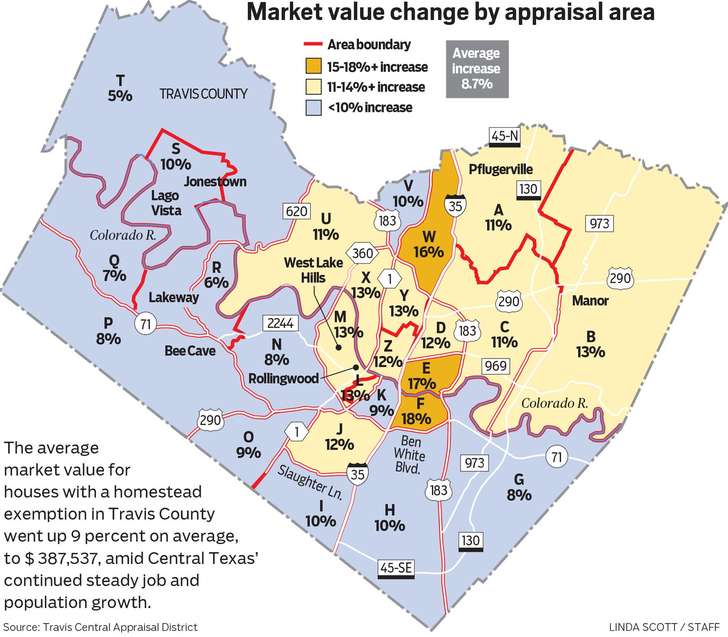
The Travis Central Appraisal District has released the data on 2016 property tax appraisals. As you can see from the map below, some of the most worrisome geographic areas in terms of gentrification are being clobbered again. Look at the dark-colored areas marked W, E and F and note that these Northeast and East Austin neighborhoods are seeing 16%, 17% and 18% appraisal increases. Beyond that, the map is dotted with other assorted double-digit increases.


IMG_0618

Click the map to enlarge it.

Austin Should Consider the Homeowner Retention Initiative

As mentioned in my previous blog posting, I have launched a comprehensive set of ideas for the City and the County to consider. The Homeowner Retention Initiative lays out a range of options to help make home ownership more affordable for both longterm residents and first-time homebuyers. The main focus however, is on our longterm residents who are consistently being priced out of their neighborhoods. The cost squeeze affects both low income and middle class homeowners and renters. So far in my discussions with City Council offices, the response has been very welcoming and encouraging. The issues are very complex and challenging. But I believe strongly that now is the time for a meeting of the minds, within both public and private civic quarters to attack and solve this critical affordability problem.

In the ongoing discussions of the initiative with City Council staff, some interesting perspectives have been raised. I would like to thank Ken Craig in Council Member Ann Kitchen’s office for suggesting that landlords could participate in some of the programs, and thereby be able to offer more affordable rents. When I met with Ashley Richardson in Council Member Renteria’s office, I was impressed with the stack of printed reports that she was prepared to study. And Michael Searle In Council Member Troxclair’s office, along with the other two policy aides, dug into the discussion with lots of detailed questions and insights. Because of some of the complexities, there will be tall mountains to climb. And we may not be able to surmount all of them. But if we can plow through some of the obstacles and achieve a measure of success, then it will have been worth the effort. On Wednesday of this week at 2:00, the initiative will be presented to the City’s Housing and Community Development Committee.

As for the Sting of the Tax Appraisals

We should not blame TCAD for the high appraisal increases. The year-after-year “clobbering” of the taxpayers is caused by the boom in Austin’s economy. Along with planning and zoning decisions. Even more importantly, the Texas Legislature maintains a steadfast insistence on relying more heavily on local property taxes to fund public services than any other large state in the country. I often hear people say, “Oh but this issue of skyrocketing property values is nothing new. California went through all that back in the 70’s and 80’s.” Well, here’s the big difference. Even back in those days, California paid its workers a living wage. And not only that, California voters passed Proposition 13, which froze taxable values at the purchase price of a home. Only after that home went back on the market did it gain a new taxable “market value.” It was an imperfect and controversial solution. But at least California had some kind of solution, along with much better salaries and wages.

We should also note that when the City of Austin, Travis County or any of the other taxing entities set their budgets, they would have to lower their tax rate in order to maintain an even level of spending from the previous year. If they actually did that, then the steep appraisal increases wouldn’t matter as much. But, unfortunately, we gaze at the Austin skyline every year and marvel at the sleek new highrises. Then we see all of the huge multifamily developments along every thoroughfare. And we ask and we wonder…

Where is all the new revenue from all of that new “tax base” going? How much new tax money is being generated each year? And why in the world are they spending it as fast as they can?

If anyone reading this can answer those questions, please drop a comment into this blog post! (And I haven’t given up on asking the City and the County for an itemized list of all of their “plans,” with a grand total of the costs and a public participation process to prioritize all of those plans).

money-flying-away1

Musical accompaniment for this blog posting:

  1. “Taxman,” – the Beatles, Revolver album, 1966
  2. “I Got Stung,” Elvis Presley, 1958

Grocery Stores Go Missing From Austin Neighborhoods – What Gives?

By Bill Oakey – April 10, 2016

As the days, weeks and years tick by in “Progressive Austin,” there is one simple basic need that seems to elude the public officials, paid consultants and public engagement document and pamphlet designers. It’s something called a grocery store. Probably most of you reading this can get to a grocery store without too much time or trouble. Even I can do it, despite not being able to drive. And the walk got easier after City Public Works finally fixed a huge pothole on Possum Trot after five attempts last year. 

But it is no secret that some of Austin’s economically challenged neighborhoods have few grocery stores or none at all. Some of these communities are located in Northeast Austin, Southeast Austin and far South Austin. The Colony Park neighborhood is one example. In nearby Walter E. Long Park, the height of the weeds is surpassed only by the number of years of master planning and official lip service. Those efforts have failed to produce anything beyond a failed November 2000 bond election for a golf course and hotel. Then came the 2014 proposal to put in two privately owned luxury golf courses without a public vote, in apparent violation of the City Charter.

One thing that the Colony Park Neighborhood and probably most other neighborhood associations would agree on is the need for access to grocery stores. We have heard all the arguments about high construction costs and whether the disposable income in some deprived areas could support grocery stores. And after all, it is largely a decision that has to be made by the private owners of such stores. But here’s a suggestion. How about looking into how other cities, counties and various researchers have approached this problem? What potential solutions are out there, and could some of them be successfully applied here?

This Picture Is Worth at Least a Thousand Words, If Not More

Perhaps this picture and the link beneath it will point somebody down at City Hall or at Travis County in the proper direction. It’s a screenshot of one page of Google search results. Feast your eyes on what the search revealed. It should certainly give us some food for thought (pun fully intended). Click here to see the picture.

To do the Google search illustrated above, click here.

For Those In Colony Park Who Want to Spin the Public Engagement Wheel…

There is a brand new set of City-sponsored public process documents here.

Mayhem

Heartwarming movie about a 1960’s housewife and her affordability problems. The grocery store scene is one of the many highlights:

“The Prize Winner of Defiance, Ohio” – Julianne Moore, Woody Harrelson, 2005

Musical accompaniment for this blog posting:

  1. Grocery store love song, “Same Old Lang Syne” – Dan Fogelberg, 1980
  2. Silly grocery store song, “Supermarket Song,” – Jewel, 2011
  3. Even sillier grocery store song, “The Grocery Store Song,” – created in Moorhead State University (Minnesota) dorm room, 2008
  4. Mind-numbing, newfangled headbanger rock, “The Grocery Store Song,” – Boy Kicks Girl (???), 2008 (remastered version)

San Francisco’s Affordability Crisis – Is This The Future For Austin?

By Bill Oakey – March 31, 2016

golden-gate-bridge

You can surely expect to find San Francisco on many historic lists of America’s most charming cities. But these days, the City By the Bay is in the throes of a major affordability crisis. That long ago dream popularized in the 1960’s by Tony Bennett with the words, “To be where little cable cars climb halfway to the stars,” today feels more like a nightmare to many longtime residents. If we think affordability is bad in Austin, which of course it is, then we need to look to San Francisco and ask if there is still time to keep things here from getting a whole lot worse.

The recent HBO documentary, “San Francisco 2.0” lays out the sad reality of a once diverse and progressive city falling victim to the encroachment of too much wealth and the perils of the economic divide. Here are a couple of snippets from the synopsis on HBO’s website:

“San Francisco has long enjoyed a reputation as the counterculture capital of America, attracting Bohemians, mavericks, progressives and activists. With the onset of the digital gold rush, young members of the tech elite are flocking to the West Coast to make their fortunes, and this new wealth is forcing San Francisco to reinvent itself. But as tech innovations lead America into the golden age of digital supremacy, is it changing the heart and soul of their adopted city?”

“Alexandra Pelosi (filmmaker) has always been proud of San Francisco, in particular its ‘long tradition of embracing nonconformity.’ She sets out to explore how the arrival of innovators – the so-called “IT invasion” – is reshaping its iconic neighborhoods and forging a tech paradise in the City by the Bay. Pelosi talks to a range of subjects, from ambitious trendsetters bringing an unprecedented wave of wealth, to the entrenched communities of artists and immigrants who are hoping to hold onto the place they call home.”

Then There Was the Recent New York Times Article

Early in March, the Times published an article entitled, “In San Francisco and Rooting for a Tech Comeuppance.” It’s not much of a stretch to think of similarities to Austin. These short excerpts explain it well:

“The consequences for people who do not make their living from technology are increasingly unpleasant. The city is bulging at the seams, adding about 10,000 people a year to a record 852,000 in 2014. A one-bedroom apartment goes for a median $3,500 a month, the highest in the nation.”

“Signs of distress are plentiful. The Fraternite Notre Dame’s soup kitchen was facing eviction after a rent increase of nearly 60 percent. (It was saved for a year after its plight received worldwide publicity). Two eviction-defense groups were evicted in favor of a start-up that intended to lease the space to other start-ups. The real estate site Redfin published a widely read blog post that said the number of teachers in San Francisco who could afford a house was exactly zero.”

“All the renters I know are living in fear,” said Derrick Tynan-Connolly, a teacher at a high school for pregnant teenagers and young mothers. “If your landlord dies, if your landlord sells the building…and you have to move, you’re gone. There’s no way you can afford to stay in San Francisco.”

San Francisco has even had their own short-term rental battle, only theirs came in the form of a referendum. The proposition, which would have placed some restrictions on Airbnb got crushed  under the weight of big money. There were 1,959 minutes of airtime opposing it, compared to only 16 minutes in support.

The Clock Is Ticking for Austin…

Austin Photo By Bill Oakey

Austin Photo By Bill Oakey

The best thing we can do as a community is stay informed and engage with our local officials. One thing that does not bode well for us is that we do not have California wages here. And we have a State government that seems hell-bent on continuing to rely on local property taxes to support schools. Not only that, the declining enrollment in AISD fueled by families with children fleeing the city is destined to get much worse. Portland school enrollment took a steep nosedive in the 1980’s when their boom cycle began pricing families out.

We Need Comprehensive Affordability Solutions

City officials are seeking public input for a new housing plan that is now being developed. You can check it out and see a schedule of public forums,  ATX Housing Community Conversations. Then please check out my recent blog posting, “Saving Austinites From Losing Their Homes – A Homeowner Retention Initiative.” And finally, we can look forward to the comprehensive affordability report to be released next month by the local nonprofit, Liveable City.

For some musical accompaniment to this blog posting, listen to “I Left My Heart In San Francisco” by Tony Bennett, 1962 and “San Francisco (Wear Some Flowers In Your Hair),” by Scott McKenzie, 1967.

Homeowner Retention Initiative – Saving Austinites From Losing Their Homes

By Bill Oakey – April 12, 2016

I have presented this proposal to the Austin City Council and two City Council committees:

Homeowner Retention Initiative

Overview: One of Austin’s biggest affordability challenges is the displacement of existing residents due to the rapid acceleration of property values, resulting in unaffordable property taxes. The housing cost spiral has helped fuel Austin’s status as the most economically segregated major city in America. One way to approach this problem is to explore creative solutions such as shared equity mortgages and shared appreciation mortgages. Local government officials should create a strong public outreach initiative so that citizens who feel at risk of losing their homes will know where to turn to seek assistance. Below I have listed both new and existing strategies that should be considered. All non-native long-term residents were newcomers when they first arrived. They are just as vital to the community, its culture and its economy as today’s newcomers.

Options to Review for Consideration

A. Shared Equity Mortgages and Shared Appreciation Mortgages

These are financing arrangements that allow a third-party investor to invest in a percentage of the equity in a home, thereby lowering the payments for the homeowner. When the house is sold, proceeds are split based on the equity ownership percentage. This mechanism should be explored both for renters seeking first time home ownership, as well as a refinancing option for long-term homeowners squeezed by high property taxes. And it could be applied to landlords needing lower mortgage payments or taxes, to facilitate lower rental rates.

­Online Resources For Shared Equity and Shared Appreciation Mortgages:

  1. “Facilitating Shared Appreciation Mortgages to Prevent Housing Crashes and Affordability Crises” – The Brookings Institution
  2. H.R. 3519 – Preserving American Homeownership Act of 2015 (See Attached Bill Summary)
  3. “Shared Equity and Housing” – Andrew Caplin, Economic Data Engineer, New York University
  4. “Shared-Equity Mortgages, Housing Affordability, and Homeownership” – Andrew Caplin, James Carr, et. all
  5. “Housing Partnerships: A New Approach to a Market at a Crossroads” – Book by Andrew Caplin
  6. “The Mortgage Mess, the Press, and the Politics of Inattention” – Andrew Caplin

Note: Determine if the concept of shared equity home ownership can be extended to older homeowners whose mortgages are paid off, but they still face an unaffordable burden of high property taxes. Can shared equity arrangements be worked out with investors willing to share the cost of property taxes?

B. Other, More Traditional Home Financing Arrangements:

  1. Shared equity with land trusts and various model comparisons – This website has a tremendous catalog of information and should be considered must-read.
  2. Co-ownership of a home – usually involving relatives or friends
  3. Reverse mortgages – should be approached with caution through consumer-based organizations

C. Continue phasing in the full 20% City of Austin general homestead exemption.

D. Consider supporting improvements to State law allowing over-65 homeowners to defer their property taxes:

  1. Reduce the annual 8% annual interest rate on the deferred tax amount.
  2. The over-65 property tax deferral option is subject to approval by each homeowner’s mortgage lender. We need to find out what criteria the lenders use, and to what extent the current climate for Austin homeowners favors or disfavors approval of tax deferrals by most lenders.

E. The City of Austin and Travis County should index the over-65 and disabled homestead exemption. They each need to adjust it annually.

F. Make sure that the current City review of a tax swap arrangement with AISD includes an offsetting adjustment to lower the tax rate for over-65 homeowners. Their school taxes are frozen when they turn 65. So a tax swap with the City without an offsetting adjustment would violate the intent of that law.

G. Seniors should be able to opt out of the City’s upcoming composting fee on our utility bills. The fees that we already have are burdensome enough, without making it worse.

H. Research and review the housing affordability and homeowner retention strategies of other cities. See this news article from Portland.

The Decline of Homeownership – Is a Single-Family Home The New Luxury Item?

Please read this disturbing article from CNBC. With homeownership at risk more so than at any time in recent history, isn’t it a good idea for Austin to step up to the plate and seek some innovative solutions?

U.S. H.R. 3519 – Preserving American Homeownership Act of 2015

(Referred to the House Committee on Financial Services. No further action to date).

Sponsored By Rep. Keith Ellison (D), Minnesota
Co-Sponsored By Rep. Louise Slaughter (D) New York
Co-Sponsored By Norma Torres (D) California

Note: A similar version of this bill was introduced in the Senate in 2014 as S. 2854 by Sen. Robert “Bob” Menendez (D), New Jersey

Bill Summary

Requires the Director of the Federal Housing Finance Agency and the Federal Housing Commissioner each to establish a pilot program to encourage, through assistance provided under the Home Affordable Modification Program under the Secretary of the Treasury’s Making Home Affordable initiative, the use of shared appreciation mortgage modifications that: (1) are designed to return greater cash flow to investors than other loss-mitigation activities, including foreclosure; and (2) result in positive net present value for the investor.

Requires a shared appreciation mortgage modification to: (1) reduce by specified action the loan-to-value ratio of a covered mortgage to 115% immediately upon modification and to 95% within 3 years; (2) reduce the interest rate if such a principal reduction would not result in an affordable reduced monthly payment; (3) reduce to a specified amount any periodic payment the homeowner is required to make; (4) require the homeowner to pay the investor, after refinancing or selling the real property securing a covered mortgage, up to 50% of the amount of any increase in the value of the real property during a specified period; and (5) result in a positive net present value for the investor after taking into account the principal reduction and, if necessary, any interest rate reduction.

Requires the Director to: (1) provide that an enterprise may negotiate regarding a shared appreciation mortgage modification of a covered mortgage with any mortgage insurance provider for a mortgage on the subject property, and (2) allow advanced claim agreements with respect to such mortgage insurance policies.

Watch The Video – March Regional Affordability Meeting

By Bill Oakey – March 31, 2016

The Austin Regional Affordability Committee met Monday March 28th. You can watch the video here. The Committee includes officials from the City of Austin, Travis County, Central Health, AISD and others. Among those are City Council Members Delia Garza, Ann Kitchen and Ellen Troxclair, Commissioner Brigid Shea, and former State Representative and current Central Health Board Member, Sherri Greenberg.

A highlight of this month’s meeting was an affordability presentation by the local nonprofit, Liveable City. This organization sponsored a collaborative gathering of citizens who divided into groups for a day-long affordability forum. The Regional Committee on Monday will also be discussing their ongoing efforts to develop an Affordability Strategic Plan. In the video, you will also see the introduction of my Homeowner Retention Initiative, along with a presentation on the critical issues facing renters from the Austin Tenants’ Council.

We have a tremendous opportunity to join together and work towards real, tangible solutions to Austin affordability. The issues are diverse and complex, but I believe that Austin abounds with the creative and innovative spirit that can truly make a difference. Hopefully, the topical elements and the results of community input obtained at the Liveable City forum will help the Committee build their Strategic Plan.

Click here for more information on the Austin Regional Affordability Committee.